
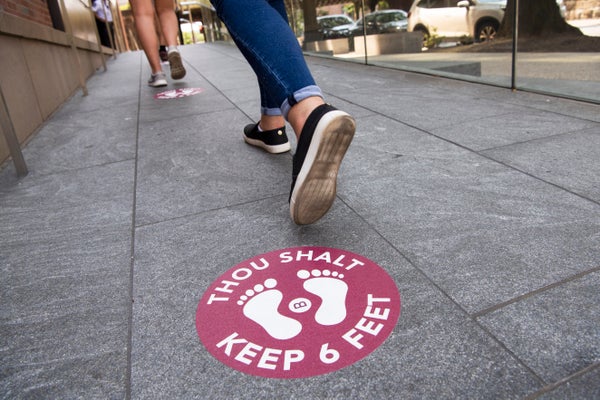
At this week’s House subcommittee hearing on COVID, Representative Marjorie Taylor Greene of Georgia mocked and disparaged Anthony Fauci, former director of the National Institute of Allergy and Infectious Diseases, who played a major role in the U.S.’s COVID response. Throughout the hearing, Greene refused to address the prominent 83-year-old scientist, who has served under seven U.S. presidents, with the title “doctor” and said he “belongs in prison.” And she accused Fauci of having made up claims about masking and the “six-foot rule” that became the norm for social distancing throughout much of the pandemic.
It’s true that scientists now know that SARS-CoV-2, the virus that causes COVID, spreads through a mixture of large and small droplets—including extremely tiny airborne droplets called aerosols that can travel farther than six feet. And the six-foot rule was never really characterized as a precise threshold for stopping exposure to the virus. But the notion that distancing was not based on any science is simply not accurate: the risk of contracting SARS-CoV-2 from an infected person drops the farther one is from that person because the concentration of the virus gets diluted by the surrounding air. And like many respiratory viruses, SARS-CoV-2 can also be spread by larger droplets from coughs or sneezes: these drops tend to fall to the ground relatively quickly, and six feet of distancing was widely seen by experts as a reasonable benchmark for avoiding that type of exposure—a recommendation that was fairly easy to remember and estimate by eye.
When the COVID-causing pathogen emerged, it was a virus that was completely new to science, and authorities understood very little about its transmissibility or any other features. They knew from work with previous respiratory viruses, such as seasonal coronaviruses and influenza viruses, that SARS-CoV-2 was likely spread via droplets expelled from the mouth and nose. In this environment of uncertainty and rapidly shifting available information, some emergency decisions were made that later proved to be errors and were corrected when frenetic research provided more information. The World Health Organization and the U.S. Centers for Disease Control and Prevention were slow to recognize that the virus was also spread through aerosols. But when emerging findings showed that it was, the WHO and CDC recommended wearing face masks and, later, high-quality respirators such as N95s. There is now extensive evidence that masks work—and that mask mandates saved tens of thousands of lives in the U.S. alone.
On supporting science journalism
If you're enjoying this article, consider supporting our award-winning journalism by subscribing. By purchasing a subscription you are helping to ensure the future of impactful stories about the discoveries and ideas shaping our world today.
Greene’s attacks on Fauci are emblematic of the broader attempt by right-wing politicians and supporters of former president Donald Trump to discredit the respected scientist, who has received—and continues to receive—numerous death threats. But the science is clear: SARS-CoV-2 was and is a threat to human health. And at a time when vaccines and effective treatments weren’t available, masking and social distancing helped curb the damage, saving countless lives.