
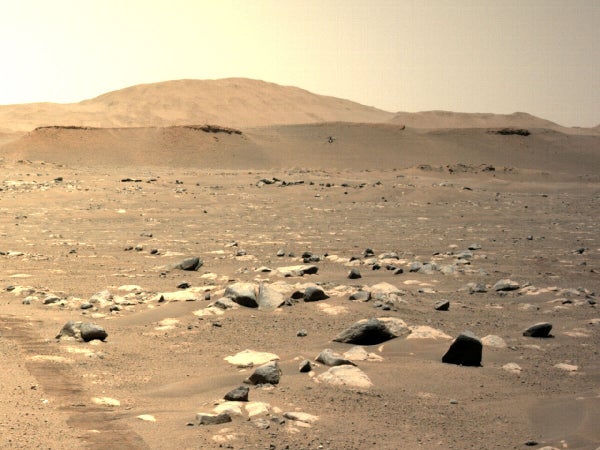
Make it a hat trick on the Red Planet for NASA’s Mars helicopter Ingenuity.
The 4-lb. (1.8 kilograms) chopper aced its third-ever Martian flight early this morning (April 25), adding to its already impressive resume.
“Third flight in the history books.” officials at NASA’s Jet Propulsion Laboratory in Southern California wrote on Twitter. “Our #MarsHelicopter continues to set records, flying faster and farther. The space chopper is demonstrating critical capabilities that could enable the addition of an aerial dimension to future missions to Mars & beyond.”
On supporting science journalism
If you're enjoying this article, consider supporting our award-winning journalism by subscribing. By purchasing a subscription you are helping to ensure the future of impactful stories about the discoveries and ideas shaping our world today.
And today’s sortie was significantly more complex than Ingenuity’s previous two flights, which took place on Monday (April 19) and Thursday (April 22), respectively. On its historic, 39-second debut hop—the first powered, controlled flight for an aircraft on a world beyond Earth—the solar-powered helicopter went straight up and down and reached a maximum altitude of about 16.5 feet (5 meters).
Ingenuity went about that high on flight number two but stayed up for nearly 52 seconds and moved side-to-side a total of 13 feet (4 m).
“For the third flight, we’re targeting the same altitude, but we are going to open things up a bit, too, increasing our max airspeed from 0.5 meters per second to 2 meters per second (about 4.5 mph) as we head 50 meters (164 feet) north and return to land at Wright Brothers Field,” Ingenuity chief pilot Håvard Grip, of NASA’s Jet Propulsion Laboratory (JPL) in Southern California, wrote in a blog post Friday (April 23). (The Ingenuity team named the chopper’s flight zone after aviation pioneers Wilbur and Orville Wright.)
“We’re planning for a total flight time of about 80 seconds and a total distance of 100 meters (330 feet),” he added.
At around 10:15 a.m. EDT (1415 GMT) today, data began streaming in to mission control at JPL confirming that Ingenuity had executed those commands successfully.
Communications to and from Ingenuity are relayed via NASA’s Perseverance rover, which is serving a key support and observation role for the helicopter. The two robots landed together inside Mars’ 28-mile-wide (45 kilometers) Jezero Crater on Feb. 18, and Ingenuity deployed from the car-sized rover’s belly on April 3, kicking off the current month-long flight campaign.
That campaign is designed to show that aerial exploration is possible on Mars, which has an atmosphere just 1% as dense as that of Earth at sea level. Ingenuity’s success could pave the way for the extensive use of rotorcraft on future Red Planet missions, with Mars helicopters serving as scouts for rovers and also gathering data themselves, NASA officials have said.
Ingenuity is not doing any science work; it’s a technology demonstration, after all. But the helicopter does have a 13-megapixel color camera, which has snapped epic, unprecedented photos of Perseverance’s tracks from above.
The Ingenuity team hopes to fly two more times before the flight window closes in early May. And these last two sorties will likely be “really adventurous,” Ingenuity project manager MiMi Aung, also of JPL, said during a news conference earlier this month, stressing that she and her colleagues want to push the little aircraft’s limits.
That will be it for Ingenuity. There’s no negotiating a longer flight window, because Perseverance needs to start focusing on its own science mission soon. That mission has two main tasks: hunting for signs of ancient Mars life inside Jezero, which hosted a lake and river delta long ago, and collecting samples for future return to Earth.
Copyright 2021 Space.com, a Future company. All rights reserved. This material may not be published, broadcast, rewritten or redistributed.