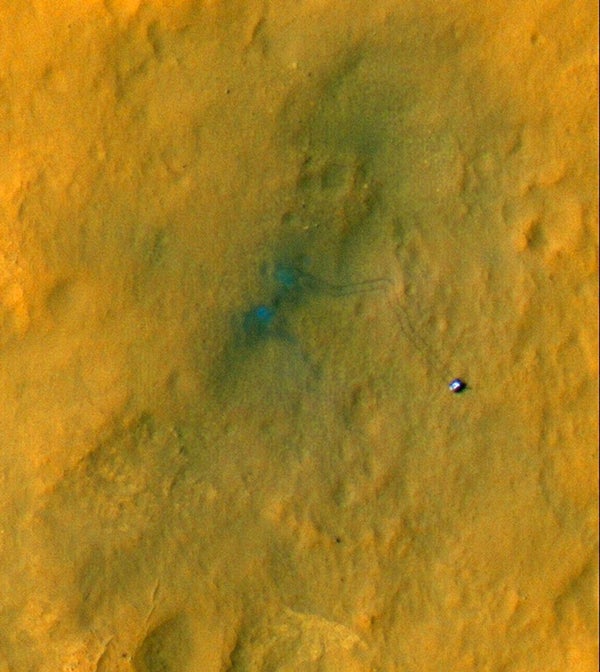
NASA's Curiosity has completed its longest trek yet. The Mars rover journeyed more than 30 meters on its 29th Martian day, which ended September 5 at 2:37 A.M.
NASA/JPL-Caltech/Univ. of Arizona
Join Our Community of Science Lovers!
NASA's Curiosity has completed its longest trek yet. The Mars rover journeyed more than 30 meters on its 29th Martian day, which ended September 5 at 2:37 A.M. Pacific Daylight Time by Earth's clock. In total, the rolling laboratory has covered 109 meters but must traverse many more to reach its first scientific sampling site. Before it proceeds, Curiosity will take a few days to test equipment on its robotic arm.
This color-enhanced image comes from NASA's Mars Reconnaissance Orbiter and reveals a slightly earlier stage in the rover's travels. On September 2, the orbiter's High Resolution Science Experiment (HiRISE) camera took this photograph, as well as images of Curiosity's fallen back shell and parachute that helped the rover land safely.
In this picture, you can clearly see the parallel tread of Curiosity's tracks. The rover's descent onto the planet disturbed soil in patches (visible near the start of the tracks), revealing the dark sands below the Red Planet's dusty surface.
On supporting science journalism
If you're enjoying this article, consider supporting our award-winning journalism by subscribing. By purchasing a subscription you are helping to ensure the future of impactful stories about the discoveries and ideas shaping our world today.
—Daisy Yuhas
It’s Time to Stand Up for Science
If you enjoyed this article, I’d like to ask for your support. Scientific American has served as an advocate for science and industry for 180 years, and right now may be the most critical moment in that two-century history.
SciAm always educates and delights me, and inspires a sense of awe for our vast, beautiful universe. I hope it does that for you, too.
If you subscribe to Scientific American, you help ensure that our coverage is centered on meaningful research and discovery; that we have the resources to report on the decisions that threaten labs across the U.S.; and that we support both budding and working scientists at a time when the value of science itself too often goes unrecognized.