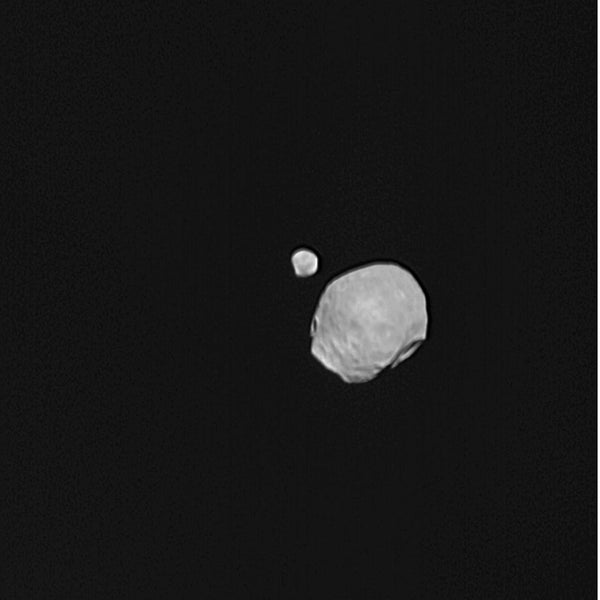
Mars orbiter lines up both Martian moons in one photo
Unlike the gas giants Saturn and Jupiter, both of which have dozens of moons, and Earth, which boasts a massive moon relative to its size that helps stabilize the planet, Mars doesn't have much in the way of lunar companions.
ESA/DLR/FU Berlin (G. Neukum)
Join Our Community of Science Lovers!
On supporting science journalism
If you're enjoying this article, consider supporting our award-winning journalism by subscribing. By purchasing a subscription you are helping to ensure the future of impactful stories about the discoveries and ideas shaping our world today.
Unlike the gas giants Saturn and Jupiter, both of which have dozens of moons, and Earth, which boasts a massive moon relative to its size that helps stabilize the planet, Mars doesn't have much in the way of lunar companions. Its two moons, Phobos and Deimos, are small, odd-shaped lumps that may be asteroids captured by Mars's gravity. Phobos, the larger of the two, is just 27 kilometers across in its broadest dimension, whereas Deimos is only about 15 kilometers across.
On November 5, the European Space Agency's Mars Express orbiter, circling the Red Planet in a polar orbit since 2003, was perfectly aligned to photograph both moons simultaneously. As Mars Express cycled through its orbit, Phobos [right] passed through its line of sight roughly 11,800 kilometers away, partially obscuring Deimos as the smaller moon cruised more slowly through its orbit some 26,200 kilometers from the spacecraft. The ESA has a stunning video of the unusual partial "eclipse," cobbled together from 130 images taken over the roughly 90-second-long event.
It’s Time to Stand Up for Science
If you enjoyed this article, I’d like to ask for your support. Scientific American has served as an advocate for science and industry for 180 years, and right now may be the most critical moment in that two-century history.
SciAm always educates and delights me, and inspires a sense of awe for our vast, beautiful universe. I hope it does that for you, too.
If you subscribe to Scientific American, you help ensure that our coverage is centered on meaningful research and discovery; that we have the resources to report on the decisions that threaten labs across the U.S.; and that we support both budding and working scientists at a time when the value of science itself too often goes unrecognized.