
On supporting science journalism
If you're enjoying this article, consider supporting our award-winning journalism by subscribing. By purchasing a subscription you are helping to ensure the future of impactful stories about the discoveries and ideas shaping our world today.
Ah, springtime: fresh flowers, fuzzy ducklings and, on Mars, the sublimation of dry ice from the surfaces of the planet's polar sand dunes.
As with the Earth's dunes, those found on Mars's northern polar erg (dune region) are chiefly shaped by wind. But a new paper published February 4 in Science shows there's another, uniquely Martian force at work as well.
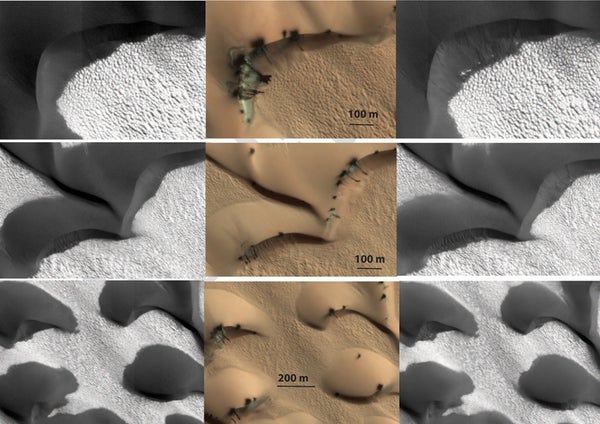
An international team of researchers examined pictures of sand dunes taken by the High-Resolution Imaging Science Experiment on board NASA's Mars Reconnaissance Orbiter. During one 687-day Martian year, the scientists found significant erosion, with the dunes forming new alcoves and gullies.
When the Red Planet's first spring sunlight hits the carbon dioxide–frosted dunes, the researchers wrote, the surface CO2 starts to sublimate (evaporate directly from a solid to a gas), thinning and cracking. Meanwhile, the bottom of the frozen CO2 sublimates, too, warmed by the Martian surface. The newly formed gas escapes through the surface cracks, taking sand with it in an avalanche.
These pictures show three dunes' shifts through the seasons. In the left column are pictures of the dunes on July 23, 2008, during an ice-free period. In the middle are false-color images of the dunes covered by dry ice. The dark streaks are cascading ice and sand. The right column shows the dunes after the ice is gone on May 28, 2010.
–Francie Diep