
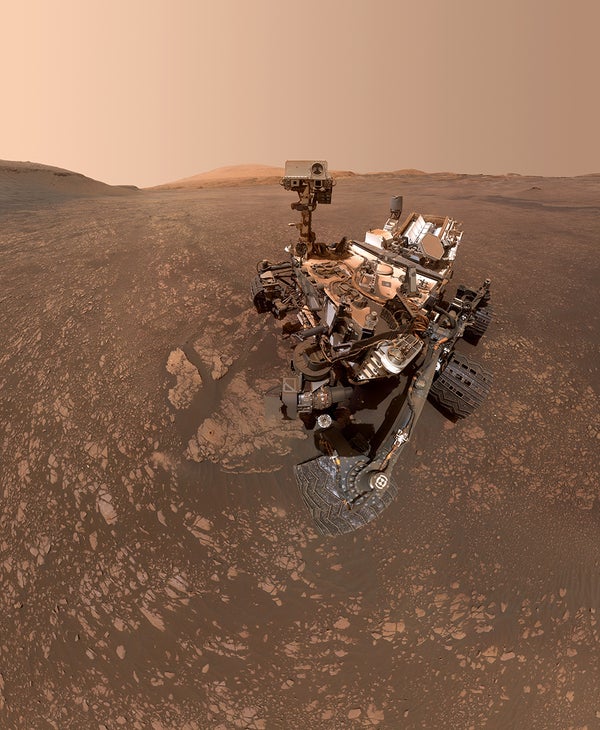
NASA’s Curiosity rover has measured the highest level of methane gas ever found in the atmosphere at Mars’s surface. The reading taken last week at Gale Crater—21 parts per billion—is three times greater than the previous record, which Curiosity detected back in 2013.
Planetary scientists avidly track methane on Mars because its presence could be a sign of life on the red planet. On Earth, most methane is produced by living things, although the gas can also come from geological sources such as chemical reactions involving rocks. Various spacecraft and telescopes have spotted methane on Mars over the past 16 years, but the gas doesn’t appear in any predictable pattern—deepening the mystery of its origin.
Curiosity has measured methane many times since it landed in Gale Crater in 2012. The level is typically low, often in the parts per trillion range, and seems to rise and fall as martian seasons change.
On supporting science journalism
If you're enjoying this article, consider supporting our award-winning journalism by subscribing. By purchasing a subscription you are helping to ensure the future of impactful stories about the discoveries and ideas shaping our world today.
The latest measurement is “excitingly huge,” says Oleg Korablev, a physicist at the Space Research Institute in Moscow. He runs one of the methane-sniffing instruments on the European-Russian Trace Gas Orbiter (TGO). The spacecraft launched in 2016 to solve the mystery of methane on Mars, but so far it has not spotted any of the elusive gas.
One explanation for that could be that methane is diluted or destroyed as it rises higher in the atmosphere, says Michael Mumma, a planetary scientist at NASA’s Goddard Space Flight Center in Greenbelt, Maryland. Orbiting spacecraft such as the TGO are best suited to measure methane many kilometers above the surface.
The TGO is now searching for methane in the atmosphere high above Gale Crater. So, too, is the European Space Agency’s Mars Express spacecraft, the other Mars orbiter that measures methane.
NASA is extending Curiosity’s stay at its current location in the crater—a spot called Teal Ridge. Agency scientists were scheduled to run a follow-up methane experiment to see whether they can confirm high levels of methane, but have not yet released their results.
This article is reproduced with permission and was first published on June 24, 2019.