
Planetary scientists are getting closer to solving the puzzle of methane on Mars.
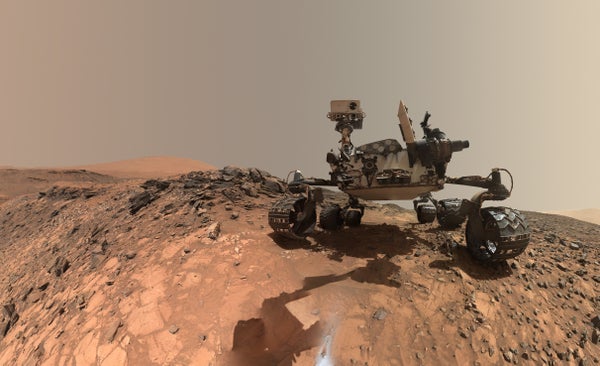
New calculations could help to explain why NASA’s Curiosity rover detects peaks of methane gas in the Martian atmosphere during the planet's northern summer. As winter gives way to spring, the idea goes, the Sun’s heat begins to warm the soil—allowing methane to percolate up from the ground and into the atmosphere, said John Moores, a planetary scientist at York University in Toronto, Canada. He presented the work at a planetary-sciences meeting on October 24.
Curiosity’s methane measurements have been tantalizing researchers for years. The rover, which landed near Mars's equator in Gale crater in 2012, at first found mysterious spikes in atmospheric methane during the northern spring. Earlier this year, team scientists reported that methane levels waxed and waned with the seasons, peaking in northern summer.
On supporting science journalism
If you're enjoying this article, consider supporting our award-winning journalism by subscribing. By purchasing a subscription you are helping to ensure the future of impactful stories about the discoveries and ideas shaping our world today.
Finding methane in Mars’s atmosphere is intriguing because chemical reactions should destroy the gas after about 300 years. Its presence today suggests that something on the planet is still sending the gas into the atmosphere. The source could be geological processes, such as reactions between certain types of rock and water—or, more intriguingly, buried microbes or other forms of life. Most of the methane in Earth’s atmosphere comes from living things.
Gas leak
Researchers have chased every whiff of methane they can find on Mars. Telescopes on Earth and spacecraft orbiting Mars have spotted the gas around the planet from time to time—including an intense plume reported in 2009. Curiosity was supposed to help solve the puzzle by measuring methane levels directly, but instead it has complicated it.
Now, it seems the answer might lie under Mars’s surface. Moores and his colleagues analysed how methane might seep upwards through cracks and fissures in the Martian soil until it enters the atmosphere. Warming the soil could allow the gas to leak into the air, their calculations show. Seasons on Mars are complex, especially at Curiosity's location so close to the planet's equator. But the highest methane levels do appear just after the warmest time of the year, suggesting that heat spreading downward allows more of the gas to be released.
The amount of gas that the scientists estimate is entering the atmosphere is a good match for the measurements Curiosity has made at Gale crater, Moores told the American Astronomical Society’s Division for Planetary Sciences meeting in Knoxville, Tennessee. The methane’s ultimate source is still a mystery. But the work could help to explain the gas’s seasonal ebb and flow, he said.
From the depths
The idea builds on earlier suggestions that methane could be seeping out of Sun-warmed cliff faces on Mars, said Michael Mumma, a planetary scientist at NASA’s Goddard Space Flight Center in Greenbelt, Maryland. When he and his colleagues reported on the intense methane plume in 2009, they suggested that pores in the Martian soil might open up on cliffs or crater walls during certain seasons, allowing methane to make its way from the subsurface to the atmosphere.
More discoveries could be coming shortly. A European–Russian spacecraft, the ExoMars Trace Gas Orbiter (TGO), has been hunting for methane and other gases in Mars’s atmosphere since April.
At the meeting, project scientist Håkan Svedhem of the European Space Agency in Noordwijk, the Netherlands, hinted to the audience that the spacecraft’s first results would be published soon. TGO measures methane all around the planet and at a range of altitudes, going far beyond what Curiosity can measure on the ground. The orbiter could help settle some of the methane-on-Mars questions once and for all.
“There will be surprising results,” said Mumma, who is part of the TGO team. He declined to elaborate.
This article is reproduced with permission and was first published on October 25, 2018.
