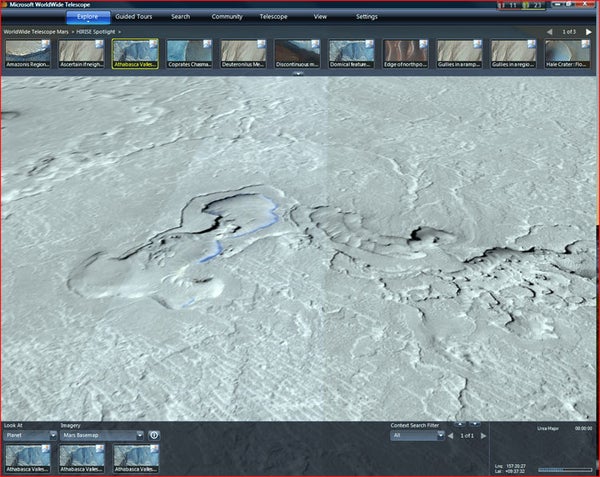
Mars's Volcanic Vents--via Microsoft
At Monday's 11th annual Microsoft Research Faculty Summit, Microsoft Corp. announced the latest version of its WorldWide Telescope (Web-based software that blends terabytes of images and other data from multiple sources, enabling personal computers to function as virtual telescopes).
On supporting science journalism
If you're enjoying this article, consider supporting our award-winning journalism by subscribing. By purchasing a subscription you are helping to ensure the future of impactful stories about the discoveries and ideas shaping our world today.
At Monday's 11th annual Microsoft Research Faculty Summit, Microsoft Corp. announced the latest version of its WorldWide Telescope (Web-based software that blends terabytes of images and other data from multiple sources, enabling personal computers to function as virtual telescopes). The software giant also revealed high-resolution, 3-D imagery of Mars stitched together with the help of more than 13,000 pictures captured by a number of NASA's Mars spacecraft, including the Mars Reconnaissance Orbiter (MRO).
The surface map has been color corrected to match the latest estimates of the Red Planet's appearance. The WorldWide Telescope features a new data set from the University of Arizona Department of Planetary Sciences' High Resolution Imaging Science Experiment (HiRISE), a remote-sensing camera onboard the MRO that collects very high–res pics, which are a quarter of a meter per pixel on average. Each HiRISE image is a gigapixel in size, containing about 100 times more information than a 10-megapixel off-the-shelf camera.
It’s Time to Stand Up for Science
If you enjoyed this article, I’d like to ask for your support. Scientific American has served as an advocate for science and industry for 180 years, and right now may be the most critical moment in that two-century history.
SciAm always educates and delights me, and inspires a sense of awe for our vast, beautiful universe. I hope it does that for you, too.
If you subscribe to Scientific American, you help ensure that our coverage is centered on meaningful research and discovery; that we have the resources to report on the decisions that threaten labs across the U.S.; and that we support both budding and working scientists at a time when the value of science itself too often goes unrecognized.
In return, you get essential news, captivating podcasts, brilliant infographics, can't-miss newsletters, must-watch videos, challenging games, and the science world's best writing and reporting. You can even gift someone a subscription.
There has never been a more important time for us to stand up and show why science matters. I hope you’ll support us in that mission.