
Summer of '45. The war is winding down. Now the call to arms is about to be replaced by a call to wings. The time has come for the Chicken of Tomorrow contest.
As Maryn McKenna details in her fun, fascinating and sometimes frightening new book Big Chicken, the aim of this nationwide breeding challenge was to create, you guessed it, a big chicken. A very big chicken. When the U.S. Department of Agriculture started keeping stats in 1925, the average weight of a chicken at slaughter was 2.5 pounds. The Chicken of Tomorrow winner, one Charles Vantress, bred a chicken that, 86 days after hatching (as per contest rules), weighed a full pound more than that. And a pound of meat multiplied by millions of chickens was worth a lot of bucks.
Nobody bothered to run a follow-up Chicken of the Day After Tomorrow contest. Nevertheless, today's massive, mass-produced U.S. birds can weigh in at six pounds—and get there in just 47 days, according to McKenna. This accelerated growth resulted from a combination of continued breeding experiments and widespread use of growth promoters—vitamins and, especially, antibiotics.
On supporting science journalism
If you're enjoying this article, consider supporting our award-winning journalism by subscribing. By purchasing a subscription you are helping to ensure the future of impactful stories about the discoveries and ideas shaping our world today.
Just as the Chicken of Tomorrow contest was wrapping up, Lederle Laboratories biochemist Thomas Jukes discovered that chickens that ate feed spiked with antibiotics really packed on the pounds. Farmers could also pack in the birds cheek by fowl, with decreased concerns about infectious diseases, thanks to this premeditated medication.
The agricultural boom took place despite warnings about the dangers of antibiotic overuse and drug resistance from the discoverer of penicillin himself, Alexander Fleming. But economic euphoria convinced most agricultural businesses to give antibiotic resistance no attention or little. (Chicken. Little. Chicken Little. It's a joke, I say, it's a joke, son.)
The love affair with antibiotics also led to a brief fad in the 1950s captured by the sales pitch “Our Poultry Is Acronized!”—a word created from Greek roots to mean “detached from time” or “timeless.” Dead chickens were dipped like little Achilles into a solution of antibiotics. The resulting surface film could make them invulnerable to microbes for up to a month—an infinity in shelf life conferred by the bird bath.
But chicken-dipping workers started getting skin infections. And foodborne illness outbreaks, though not necessarily related to the dipping, prompted fresh research. “Acronizing treatment changed the mix of bacteria on the surface of meat,” McKenna writes, “encouraging resistant bacteria to develop and multiply.” Eventually a new slogan pitched chickens: “Non-Acronized.” Tempus sure does fugit.
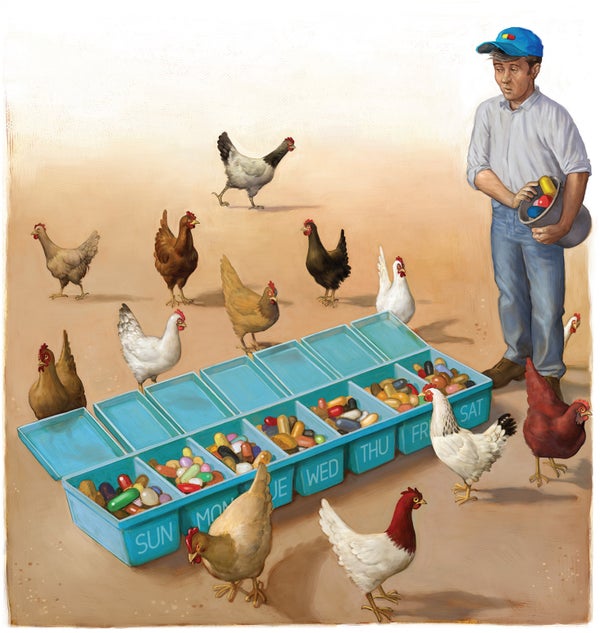
All this tinkering—without genetic modification in the modern GMO sense, by the way—has been part of a chicken explosion. In 1909, McKenna writes, “in the entire United States, 154 million chickens were sold for meat.” Today the figure is almost nine billion. That's a lot of chicken salad (especially with the human population increasing only about fourfold). And the vast majority of antibiotics sold in the U.S.—some 80 percent—go to animals. Because most of those drugs are also used to fight human infections, drug-resistant bugs that arise on the farm continue to threaten our own health.
But an almost breathtaking development (not the result of a respiratory infection) is under way. As McKenna notes, in 2014 Perdue Farms chair Jim Perdue (who holds a fisheries doctorate, go figure) announced that his company had stopped using growth-promoting antibiotics in 2007—and was still able to raise profitable poultry. It helped that Perdue's research showed that growth promoters had lost their oomph, but let's not look a gift chicken in the beak. A few months before Perdue went public, Chick-fil-A joined the same sect, declaring that its chicken would be antibiotic-free by 2019. McDonald's, Subway, Costco, Walmart all followed, as did Tyson Foods—America's most prolific chicken king.
As antibiotic-raised chicken flickers across the land, recall the poetic words of Emily Dickinson: “Hope is the thing with feathers.” Even if it ends up plucked.