
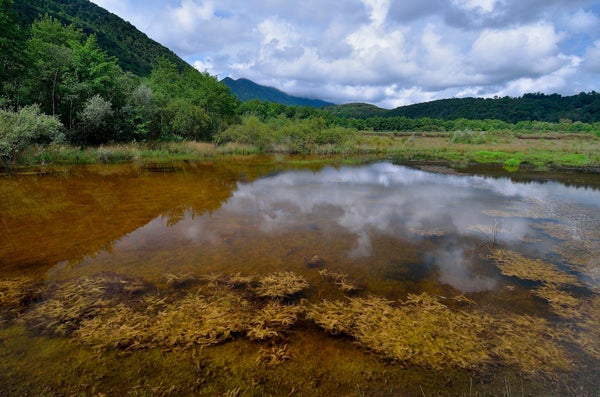
One of the world's most important carbon-storing ecosystems may be more resilient to environmental change than previously suspected, scientists have just reported. And that could be good news for addressing global warming.
A new study, released Friday in the journal Nature Communications finds that plants in carbon-rich European peat bogs are able to adapt to changes in temperature, precipitation and other climate-related factors. As the environment changes, specific types of plants may die off and be replaced by new species—but the study suggests that the incoming species tend to be similar to the old ones, meaning the stability of the bog is preserved.
That's important news to scientists, given the significance of peat bogs worldwide in the global carbon cycle. These wetland ecosystems contain live vegetation at the surface, but house extensive stores of dead, carbon-rich organic matter underground. They're found everywhere from Indonesia to the Arctic, although they're concentrated mainly in the northern regions.
On supporting science journalism
If you're enjoying this article, consider supporting our award-winning journalism by subscribing. By purchasing a subscription you are helping to ensure the future of impactful stories about the discoveries and ideas shaping our world today.
Scientists believe the world's peat bogs can contain up to 500 billion metric tons of carbon—that's about 50 times more carbon than is emitted into the atmosphere each year by the burning of fossil fuels. This makes them a huge point of concern among climate scientists.
While peat bogs now serve as some of the world's biggest terrestrial carbon sinks, scientists worry that environmental disturbances—the drying effects of climate change, land-clearing and drainage, wildfires and other human activities—could cause the underlying organic matter to decompose and release vast amounts of carbon into the atmosphere.
Scientists are already seeing glimpses of that. Wildfires in Indonesia have been known to release massive amounts of carbon into the atmosphere over short periods of time. In 2015 alone, scientists estimate Indonesian peat fires were responsible for about 1.5 billion tons of carbon emissions. As a result of mounting environmental concern, the Indonesian government last year placed a moratorium on any human activities that could damage the nation's peat bogs.
Now, the new study suggests that these ecosystems might be pretty good at weathering climatic change—up to a point, at least.
The research focuses on 56 peat bogs throughout Europe existing under different climatic and environmental conditions, a scope that could be "unprecedented" in the study of peatlands, according to Mike Waddington, a wetlands expert at McMaster University in Canada, who was not involved with the research.
With the help of models, the researchers—more than a dozen scientists from institutes throughout Europe—analyzed data on the species found in the bogs alongside data on climate variables like temperature, moisture and precipitation. They also looked at nitrogen and sulfur found in the area.
They found that changes in these variables, particularly temperature and precipitation, can cause significant levels of species turnover, with certain types of plants dying off once the surrounding environment is no longer suitable. But the plants that remain, and the newcomers, tend to be functionally similar, meaning they have many of the same characteristics of the old ones. In other words, even though the species composition may shift in response to changes in the climate, the bog itself can remain largely unaffected.
That's because the plants tend to cluster together in two distinct, complementary groups. Plants in one group tend to react differently to environmental change than plants in the other group. But the plants in the groups tend to be functionally similar and together are able to maintain the bog's overall stability.
"It's a bit of a good news story for sure," Waddington told E&E News. The vegetation at the surface of the bogs is important for maintaining the health of the ecosystem and protecting the peat that lies beneath from decomposing, he said.
And because the types of vegetation found in peat bogs tend to be similar in other parts of the world, it's likely that European bogs aren't the only ones exhibiting such resiliency, he added.
Still, the researchers warn against overselling the strength of peatlands. Using models, they demonstrated that more severe disturbances could cause the system to fail, with new species eventually being replaced by functionally different ones, changing the character of the bog.
This means peatlands affected by multiple different disturbances at once—the effects of climate change on top of human pollution or land-use changes, for instance—could overwhelm the ecosystems, Waddington cautioned. And he added that scientists still aren't sure if future climate change could eventually outpace the bogs' ability to adapt.
"This peatland ecosystem is changing in response to environmental change and external drivers," he said. "What is not known is how fast that change can be, where you might see a different result."
According to the researchers, this speaks to the importance of serious conservation efforts. As the environment continues to change, they write, "plant communities will change as species migrate to areas where environmental conditions are suitable."
To ensure that functionally similar plant species are able to move between the bogs and take each other's places, the researchers recommend a concerted effort to protect all of these ecosystems across the European landscape and all the vast array of plant species they house.
"It really leads to the necessity for conservation of these types of ecosystems because of the amounts of carbon that are in them," Waddington said.
Reprinted from Climatewire with permission from E&E News. E&E provides daily coverage of essential energy and environmental news at www.eenews.net.
