On supporting science journalism
If you're enjoying this article, consider supporting our award-winning journalism by subscribing. By purchasing a subscription you are helping to ensure the future of impactful stories about the discoveries and ideas shaping our world today.
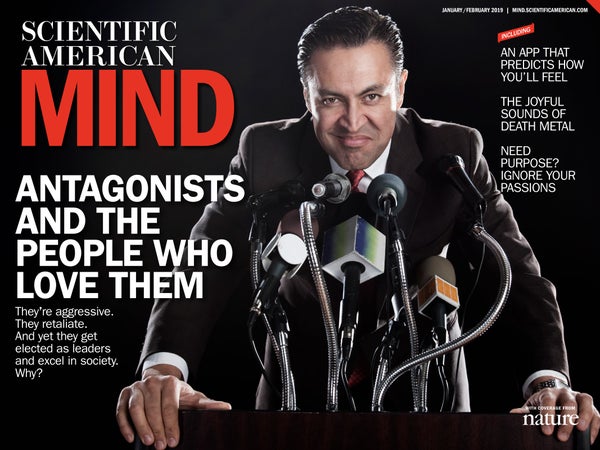
Many of us could easily name someone in the public eye (or even our private circle) whose aggressive personality only seems to get them more ahead in life. Do nice guys (and gals) truly finish last? Scientific American columnist Scott Barry Kaufman digs into this question in “The Personality Trait That Is Ripping America (and the World) Apart,” especially as it pertains to political beliefs. It turns out that highly antagonistic leaders have a special ability to fire up certain groups of people who share some of those antagonistic personality tendencies. Talk about screaming into the echo chamber.
Elsewhere in this issue, psychologists are developing apps that, they claim, can predict severe mood crashes—especially important for patients suffering from depression, as Matt Kaplan reports in “Happy, with a 20 Percent Chance of Sadness.” And Cindi May, professor of psychology at the College of Charleston, makes the case that rather than follow our passions down one career path, we should invest in different interests and multiple fields (see “Life Advice: Don’t Follow Your Passion”). As always, we welcome your feedback. Enjoy!
Subscribe to Support Independent Journalism
Great science journalism requires human expertise, time, effort and creativity. And it costs money. That’s why I and the journalists here at Scientific American hope you’ll join our community.
When you subscribe, you are supporting staff and freelance journalists who are passionate about telling science stories that are true, important and compelling. Our editors and reporters are often experts in their fields, which means they understand the nuances of big discoveries and can untangle the breakthroughs from the hype. With a subscription, you are also supporting rigorous fact-checking to ensure the words we publish are precise and accurate. And you’re supporting original illustrations, graphics and photos that bring you closer to an advanced laboratory, an ice sheet in Antarctica or a space mission in orbit. You’re helping us craft other types of high-quality journalism as well: Our newsletters are carefully written, edited and curated by staffers you have or will come to know and love. Our Science Quickly podcast is based on original reporting, collaboration with editors and scientists and exacting production.
Subscriptions keep this engine running so we can continue to deliver thoughtful, rigorous and independent science journalism to you. In an era of viral misinformation, this work is crucial. If you value what we do, I hope you’ll consider joining us as a subscriber