
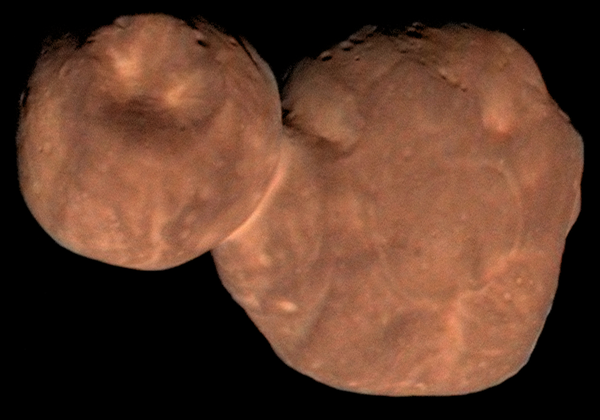
Hopefully you weren’t too attached to “2014 MU69,” because the most distant object ever explored has a new name.
The 21-mile-wide (34 kilometers) body visited by NASA’s New Horizons spacecraft on Jan. 1 is now officially known as Arrokoth, a term that means “sky” in the Powhatan/Algonquian language, mission team members announced today (Nov. 12).
“The name ‘Arrokoth’ reflects the inspiration of looking to the skies and wondering about the stars and worlds beyond our own,” New Horizons Principal Investigator Alan Stern, of the Southwest Research Institute (SwRI) in Boulder, Colorado, said in a statement. “That desire to learn is at the heart of the New Horizons mission, and we’re honored to join with the Powhatan community and people of Maryland in this celebration of discovery.”
On supporting science journalism
If you're enjoying this article, consider supporting our award-winning journalism by subscribing. By purchasing a subscription you are helping to ensure the future of impactful stories about the discoveries and ideas shaping our world today.
Like the Powhatan people, New Horizons has strong ties to Maryland and the greater Chesapeake Bay region. The mission is run by The Johns Hopkins University Applied Physics Laboratory in Laurel, Maryland. And New Horizons team members discovered Arrokoth using NASA’s Hubble Space Telescope, which is operated by the Space Telescope Science Institute in Baltimore. The scientists also relied heavily on Hubble observations to plan the flybys of both Arrokoth and Pluto.
The epic Pluto encounter, which took place in July 2015, was the centerpiece of New Horizons’ primary mission. The flyby of Arrokoth was the focus of the probe’s extended mission, and it occurred when New Horizons was about 4 billion miles (6.4 billion kilometers) from Earth.
Arrokoth, which the New Horizons team nicknamed “Ultima Thule,” is one of many frigid bodies way out in the Kuiper Belt, the solar system’s “third zone” beyond Neptune’s orbit. Small Kuiper Belt objects such as Arrokoth are time capsules of a sort, having existed more or less unchanged for more than 4 billion years, scientists say. (New Horizons found that the much larger Pluto, by contrast, shows signs of relatively recent geological activity.)
“Data from the newly named Arrokoth has given us clues about the formation of planets and our cosmic origins,” New Horizons team member Marc Buie, also of SwRI, said in the same statement. “We believe this ancient body, composed of two distinct lobes that merged into one entity, may harbor answers that contribute to our understanding of the origin of life on Earth.”
According to conventions established by the International Astronomical Union (IAU), the discoverers of a cosmic body have the privilege of naming it. The New Horizons team got the consent of Powhatan tribal representatives before proposing Arrokoth to the IAU, NASA officials said. And Rev. Nick Miles of the Pamunkey Tribe, which was part of the original Powhatan Confederacy, opened the Arrokoth naming ceremony at NASA headquarters today with a traditional Algonquian song.
“We graciously accept this gift from the Powhatan people,” Lori Glaze, director of NASA’s Planetary Science Division, said in the same statement.
“Bestowing the name Arrokoth signifies the strength and endurance of the indigenous Algonquian people of the Chesapeake region,” Glaze added. “Their heritage continues to be a guiding light for all who search for meaning and understanding of the origins of the universe and the celestial connection of humanity.”
Copyright 2019 Space.com, a Future company. All rights reserved. This material may not be published, broadcast, rewritten or redistributed.