
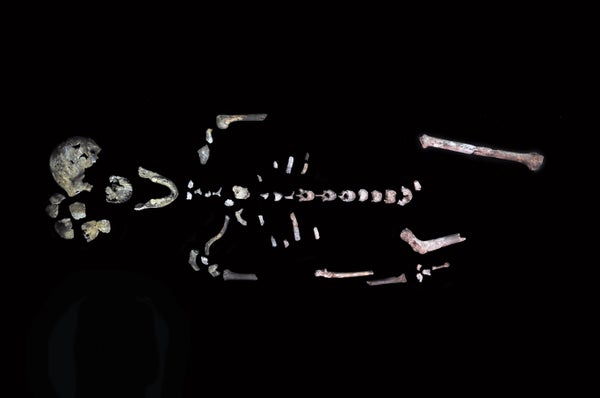
In 2015 Lee Berger of the University of the Witwatersrand, Johannesburg, and his colleagues caused a sensation when they unveiled more than 1,500 human fossils representing some 15 individuals, male and female, young and old, discovered in South Africa. It was one of the richest assemblages of human fossils ever found, recovered from a chamber deep inside an underground cave system near Johannesburg called Rising Star. The team deduced that the bones belonged to a new species, Homo naledi, which had a curious mix of primitive traits, such as a tiny brain, and modern features, including long legs. The scientists determined it was a capable climber and long-distance walker and surmised that it had disposed of its dead in the pitch-dark, hard-to-reach chamber.
Yet for all that the researchers were able to glean from the bones, the discovery was perhaps best known for what they could not ascertain: its age.
That eagerly awaited piece of the puzzle has finally fallen into place. In papers published online May 9 in eLife, the team reports it has dated the remains of H. naledi to between 236,000 and 335,000 years old—surprisingly young for a species with such a small brain. The researchers also announced the discovery of yet more fossils of H. naledi in a second chamber in Rising Star, including a skeleton of an adult male they nicknamed Neo, “gift” in the local Sesotho language.
On supporting science journalism
If you're enjoying this article, consider supporting our award-winning journalism by subscribing. By purchasing a subscription you are helping to ensure the future of impactful stories about the discoveries and ideas shaping our world today.

Sum of its parts: Reconstruction of the pieces of Neo's skull reveals the visage of Homo naledi. To read more about the new discoveries, visit www.ScientificAmerican.com/neo. Credit: John Hawks University of the Witwatersrand, Johannesburg
The findings raise intriguing questions about the origin and evolution of our genus, Homo. Despite the young age of the bones, the scientists maintain that H. naledi's primitive features link it to much earlier members of the human family, and they argue that this species might even be a direct ancestor of Homo sapiens.
Berger and his collaborators also note that the new dates for H. naledi indicate it lived at a time when human ancestors were making sophisticated stone tools in the Middle Stone Age tradition. Many of the sites where archaeologists have discovered these tools do not contain any human fossils. Experts have typically assumed that large-brained humans made the implements. But if H. naledi was around at that time, as the authors suggest, it cannot be excluded as the toolmaker. In that case, scientists will need to reconsider the enduring notion that brain size drives complexity of behavior. Paleoanthropologist Mark Collard of Simon Fraser University in British Columbia, who was not involved in the new work, thinks there is good reason to do so: “The history of paleoanthropology is littered with deeply rooted assumptions that have been overturned by new discoveries.”