
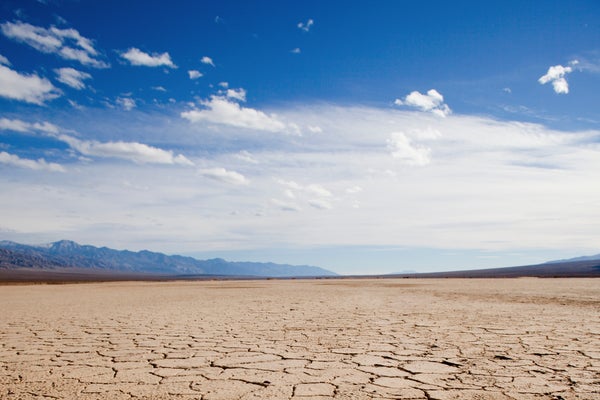
Loss of ice cover in the Arctic could spur more droughts in California, according to a new study by federal researchers.
The study, published today in Nature Communications, finds that sea-ice loss in the Arctic could trigger atmospheric effects that drive precipitation away from California. The research was led by atmospheric scientists at the Lawrence Livermore National Laboratory.
It's the same kind of effect that contributed to state's historic dry period that ended last year. The five-year drought was exacerbated by an atmospheric pressure system in the North Pacific Ocean that researchers dubbed the "ridiculously resilient ridge," which pushed storms farther north and deprived the Southwest of precipitation.
On supporting science journalism
If you're enjoying this article, consider supporting our award-winning journalism by subscribing. By purchasing a subscription you are helping to ensure the future of impactful stories about the discoveries and ideas shaping our world today.
"[S]ea-ice loss of the magnitude expected in the next decades could substantially impact California's precipitation, thus highlighting another mechanism by which human-caused climate change could exacerbate future California droughts," the study says.
The study stops short of attributing California's latest drought to changes in Arctic sea ice, partly because there are other phenomena that play a role, like warm sea surface temperatures and changes to the Pacific Decadal Oscillation, an atmospheric climate pattern that typically shifts every 20 to 30 years.
The recent drought is also outside the study's scope because the researchers focused on potentially larger losses in sea ice than have occurred to date. The authors predict that over the next 20 years, California could see a 10 to 15 percent decrease in rainfall on average.
"The recent California drought appears to be a good illustration of what the sea-ice drive precipitation could look like," lead researcher Ivana Cvijanovic said in a release. "While more research should be done, we should be aware that an increasing number of studies, including this one, suggest that the loss of Arctic sea ice cover is not only a problem for remote Arctic communities, but could affect millions of people worldwide."
Conversely, sea-ice loss in the Antarctic would be expected to increase California's precipitation, according to the study's modeling. The North Pacific atmospheric ridge would be replaced by a trough, encouraging tropical storms to develop over the state.
Previous studies have hypothesized that the North Pacific atmospheric ridge is caused by increased ocean surface temperatures and movement of heat in the tropical Pacific. The new study elaborates on that understanding by describing the link between Arctic sea-ice loss and tropical convection.
The study could help narrow the range of uncertainty around how climate change is expected to alter California's precipitation patterns. Better modeling of Arctic sea-ice changes could improve prediction of changes in rainfall, the researchers said.
Reprinted from Climatewire with permission from E&E News. E&E provides daily coverage of essential energy and environmental news at www.eenews.net.
