
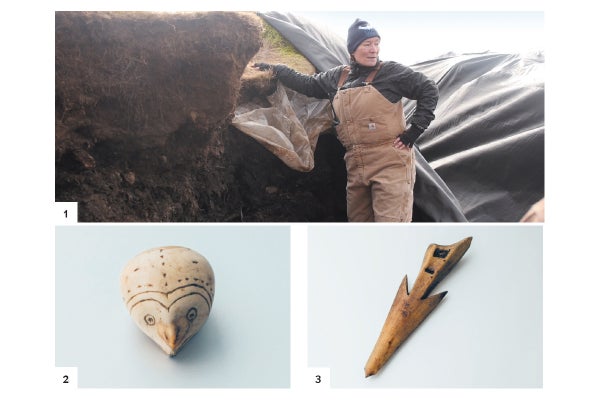
Archaeologists who work in the Arctic are typically spoiled with pristinely preserved artifacts, but recently the blessing of ice has become a curse: the researchers are struggling to save the wealth of delicate material that is emerging from melting permafrost and eroding coastlines because of climate change. In northern Alaska there is only one full-time archaeologist: Anne Jensen, a senior scientist at Ukpeaġvik Iñupiat Corporation, one of the largest companies owned by Alaskan natives. Every summer Jensen excavates hard-to-access sites where Inuit people lived and hunted hundreds—even thousands—of years ago. This past summer Jensen and her colleagues returned to Walakpa, once the site of a coastal village that continues to reveal surprises because of erosion. They hope to save thousands of years' worth of cultural and environmental data from falling into the sea.
What did you find at Walakpa this time?
Walakpa could go back 4,500 years or more. So far houses, tent platforms and various storage pits have been found. Also, people threw trash down the hill, so you have these beautifully stratified middens, which are basically garbage piles. We spent a lot of time taking faunal samples for chemical analysis and radiocarbon dating.
What's the most challenging part of being an archaeologist on the North Slope?
Definitely the weather. You have a fairly short excavation season—only between six weeks and two months long. The ground is frozen except for the upper layers, so after you remove the thawed materials, excavation goes more slowly.
On supporting science journalism
If you're enjoying this article, consider supporting our award-winning journalism by subscribing. By purchasing a subscription you are helping to ensure the future of impactful stories about the discoveries and ideas shaping our world today.
Scientists have established that the Arctic is warming at a faster pace than the rest of the planet. How does that affect your job?
Everything has been so well preserved. Many organic remains—such as baleen strips, leather goods, ivory carvings, wood bows, bone fragments and even mummies—can be 1,000 years old or more, but they look like they were buried 10 years ago. That's because they froze quickly, which slows chemical and bacterial action, and then never unfroze.
But that's changing. Climate projections are dire: some scientists say there will be no permafrost by the end of the century in locations such as Point Hope and Kivalina. Even at Point Barrow, the layer of soil that thaws during summer and freezes during winter is going to be close to six feet, which encompasses most archaeological material. That means everything is going to go through the freezing and thawing cycle every year, which is really destructive—and not just chemically. Ice crystals also mechanically deteriorate things. Plus, the sea level is rising. Plus, there's much higher risk of erosion for the coastal sites. Already across the northern coast of Alaska there are very few sites left, and many have been lost recently. Sites that people told me about 15 years ago are now gone.
What's at risk of being lost?
We may never be able to answer the question of how and why proto-Inuit people migrated from here to the eastern Arctic. And we're not only losing the cultural data. We basically look at the middens as frozen-tissue archives, which have a great deal of information about how ecosystems functioned at different points. Put that together with climate data and you can gradually piece together a much better understanding of ecodynamics. For example, you can figure out how walrus populations changed over time, which could inform today's hunting and conservation policies.
What could be done to protect and preserve these archaeological sites?
It's just not feasible to protect them in the long term. Ukpeaġvik Iñupiat Corporation is going to great lengths to preserve Walakpa a little longer so we can excavate more of it. But not all village corporations have the resources we do. The only option at this point is to identify the sites we think have the best preservation and the highest potential to address a lot of scientific questions and figure out a way to salvage them. They can't be preserved.
Do you have a favorite artifact that you've discovered?
A little ivory toggle or fastener from a burial at Nuvuk, at the tip of Point Barrow (2). It's a really great little owl carving. The burial date is between A.D. 875 and 1080, so assuming the owl wasn't an even older family heirloom, it is about 1,000 years old.