
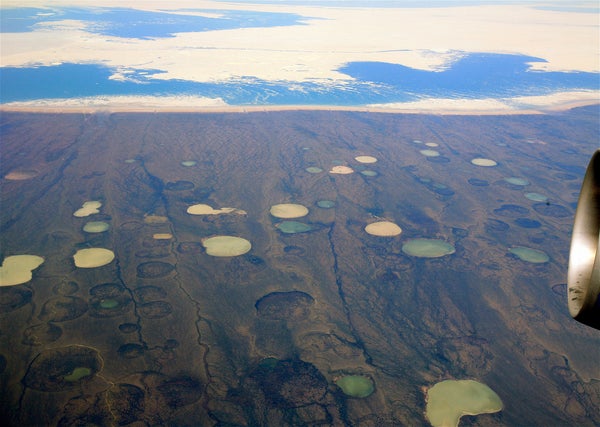
Melting permafrost is causing significant changes to the freshwater chemistry and hydrology of Alaska’s Yukon River and could be triggering global climate impacts, according to a U.S. Geological Survey report released yesterday.
Researchers say the study, which analyzed more than 30 years of data, sheds light on how climate change is already affecting the Arctic.
According to the report, the Yukon River and one of its major tributaries have accumulated increasing levels of calcium, magnesium and sulfates over the last three decades due to thawing permafrost.
On supporting science journalism
If you're enjoying this article, consider supporting our award-winning journalism by subscribing. By purchasing a subscription you are helping to ensure the future of impactful stories about the discoveries and ideas shaping our world today.
The Yukon River Basin, which is the size of California, originates in British Columbia and flows northwest through the interior of Alaska. It empties into the Bering Sea along Alaska’s southwestern coast. Once the river water reaches the sea, it streams north to the Arctic Ocean, where it affects the ocean’s circulation and chemical makeup.
“As the climate gets warmer, the thawing permafrost not only enables the release of more greenhouse gases to the atmosphere, but our study shows that it also allows much more mineral-laden and nutrient-rich water to be transported to rivers, groundwater and eventually the Arctic Ocean,” explained Ryan Toohey, a researcher at the Interior Department’s Alaska Climate Science Center in Anchorage and the lead author of the study.
“Changes to the chemistry of the Arctic Ocean could lead to changes in currents and weather patterns worldwide,” he said.
According to the report, higher temperatures in Alaska from 1982 to 2014 caused increasing permafrost loss. As the frozen layer thawed, it caused the upper active layer of ground to expand, opening new pathways for water to flow through soil, bedrock and groundwater. Ultimately, those changes altered the chemical composition of surface water and groundwater.
The increasing permafrost loss has caused a jump in the annual pulse of naturally occurring sulfates in the Yukon River.
The chemical composition is also affected by how long the river stays frozen each winter. Over the years, the Yukon River ice has been breaking up earlier and freezing up later. When the Yukon is unfrozen, its banks and soils are more susceptible to erosion, causing dramatically higher levels of phosphorus to enter the river water.
The resulting aquatic ecosystems impacts may ultimately contribute to changes in the Arctic Ocean, the report said. The research concluded that permafrost degradation is already fundamentally transforming the way that high-latitude Northern Hemisphere ecosystems function.
The study is the first to use long-term continuous water chemistry data to document hydrological changes over an enormous geographic area and a long time span. It is due to be published in the American Geophysical Union’s Geophysical Research Letters.
USGS reported that another recent study documented similar changes on the Mackenzie River in Canada, which also flows into the Arctic. Toohey said the two studies strongly suggest that permafrost loss is leading to massive changes in hydrology within the Arctic and boreal forests that may have consequences for the carbon cycle, fish and wildlife habitat and other parts of the ecosystem.
Reprinted from ClimateWire with permission from E&E News. E&E provides daily coverage of essential energy and environmental news atwww.eenews.net.