
Mentally replaying a memory can be helpful for recalling key details, such as picturing the moment you last arrived home to remember where you put your keys. This ability to relive a past moment (or even imagine a future one) is what psychologists call “mental time travel.” While scientists once thought this ability was unique to humans, evidence of flashback-style memory has now been found in great apes, cuttlefish and rats. And now, in research published on Wednesday in PLOS ONE, researchers have demonstrated that birds called Eurasian Jays can do it, too, expanding our understanding of intelligence and recall in animals.
Mental time travel is an exercise in episodic memory, a form of long-term memory for events. Unlike semantic memory, which allows us to recall facts and information, episodic memory allows us to reconstruct a scene in our mind, including details that we might not have deemed important enough to note at the time.
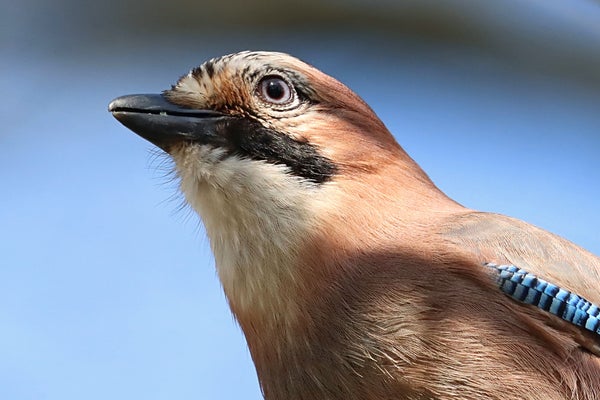
Eurasian Jays (Garrulus glandarius) have excellent memory: they stash foods such as nuts and larvae for future consumption, so remembering the place, contents and timing of these food stores is crucial for their survival. They also have complex mental abilities such as object permanence and spatial memory and do another form of mental time travel to plan for the future. This made the researchers curious to know whether Eurasian Jays might revisit memories like we do by testing whether they remember information as part of an entire encoded memory—even information not considered relevant at the time of the event.
On supporting science journalism
If you're enjoying this article, consider supporting our award-winning journalism by subscribing. By purchasing a subscription you are helping to ensure the future of impactful stories about the discoveries and ideas shaping our world today.
In the experiment, seven birds watched experimenters place food beneath one cup in a line of identical cups. They were rewarded for later picking the correct cup out of the same lineup. This training, repeated multiple times, required only that the birds remember the correct cup’s position in line.
Then the jays were given a different memory assessment in which they saw food placed beneath one of several cups with differently colored shapes or patterns. Ten minutes later they were brought back to these nonidentical cups, which had been shuffled into a different order. If the bird only remembered what it was trained to recall—the correct cup’s position in the lineup—it would have been fooled by this switch-up. But instead the birds were largely able to access visual details that they hadn’t known they would need, says James Davies of the University of Cambridge, a psychologist and lead author of the study. The jays correctly chose the cup with the food 70 percent of the time based on those visual features.
This method is one of the best ways to test episodic memory in animals, says Jonathon Crystal, a psychologist at Indiana University Bloomington, who was not involved in the research. Although we can’t know for sure if birds experience memory in the same way we do, Crystal says this experiment is a powerful indicator of something like episodic memory because the jays did not know color and pattern would be important when they first saw it. “When you get the answer right, you have to be retrieving an episode and finding the relevant information now that you know you need this information,” Crystal says.
Rachael Shaw, a biologist at Victoria University of Wellington in New Zealand, who has also studied the mental abilities of Eurasian Jays, says she wouldn’t be surprised if all birds in the corvid family have something like episodic memory. “I think all of the evidence is pointing that way,” she says. “Is it exactly like ours? I don’t think we’ll ever know.”
Still, studying the same cognitive abilities in multiple species “can tell us something about how these abilities evolved or about how intelligence in general evolved,” Shaw says. Next, the researchers hope to get a clearer picture of the jays’ memory abilities by testing their limits, Davies says. Human episodic memory is quite flexible—it can apply to situations that don’t have to do with food or survival—so the researchers suggest exploring whether Eurasian Jays’ memory abilities are sharp in non-food-related situations as well.