
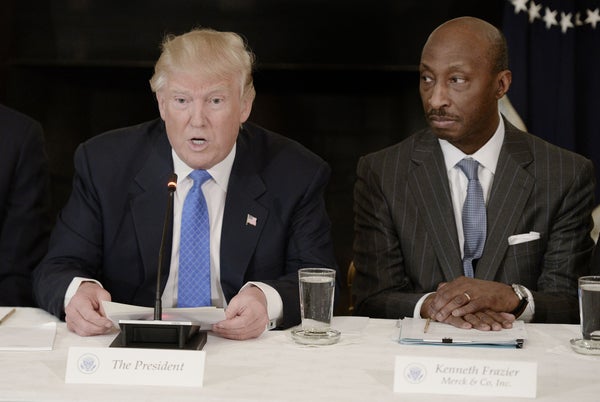
Merck & Co Inc Chief Executive Kenneth Frazier resigned from U.S. President Donald Trump's American Manufacturing Council on Monday, saying he was taking a stand against intolerance and extremism.
A gathering of hundreds of white nationalists in Virginia took a deadly turn on Saturday when a car plowed into a group of counter-protesters and killed at least one person.
Trump had said "many sides" were involved, drawing fire from across the political spectrum for not specifically denouncing the far right.
On supporting science journalism
If you're enjoying this article, consider supporting our award-winning journalism by subscribing. By purchasing a subscription you are helping to ensure the future of impactful stories about the discoveries and ideas shaping our world today.
"America's leaders must honor our fundamental views by clearly rejecting expressions of hatred, bigotry and group supremacy, which run counter to the American ideal that all people are created equal," Frazier, who is African-American, said in a statement announcing his resignation. (bit.ly/2fFnITM)
"As CEO of Merck and as a matter of personal conscience, I feel a responsibility to take a stand against intolerance and extremism," he said.
Trump responded in a tweet, now that "Ken Frazier of Merck Pharma has resigned from President's Manufacturing Council, he will have more time to LOWER RIPOFF DRUG PRICES!"
Several executives from top U.S. companies have stepped down from a number of presidential advisory councils in protest to Trump policies.
Tesla Inc CEO Elon Musk and Walt Disney Co CEO Robert Iger left the President’s Strategic and Policy Forum, a business advisory group, in June, after Trump said he would withdraw from the Paris climate accord. Musk also left the manufacturing council.
Former Uber Technologies Inc [UBER.UL] CEO Travis Kalanick quit the business advisory council in February amid pressure from activists and employees who opposed the administration's immigration policies.
The White House said Sunday that Trump's remarks condemning violence at a white nationalist rally were meant to include the Ku Klux Klan and neo-Nazi groups.
Democrats and Republicans criticized Trump for waiting too long to address the violence - his first major domestic crisis as president - and for failing when he did speak out to explicitly condemn white-supremacist marchers who ignited the melee.
Trump on Saturday initially denounced what he called "this egregious display of hatred, bigotry and violence on many sides."
On Sunday, however, the White House added: "The president said very strongly in his statement yesterday that he condemns all forms of violence, bigotry, and hatred, and of course that includes white supremacists, KKK, neo-Nazi, and all extremist groups. He called for national unity and bringing all Americans together."