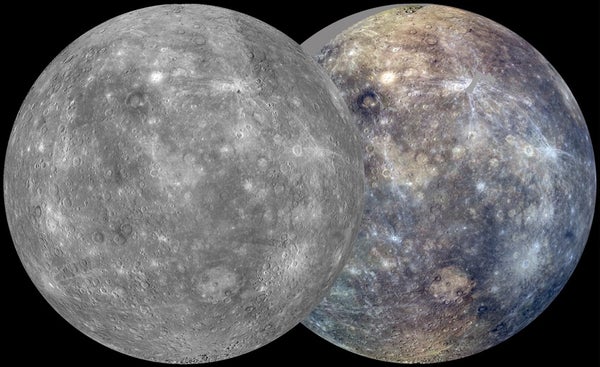
NANTES, France—NASA's Messenger spacecraft has been orbiting Mercury for more than six months, but that's all in a day's work, Mercury time.
NASA/Johns Hopkins University Applied Physics Laboratory/Carnegie Institution of Washington
Join Our Community of Science Lovers!
On supporting science journalism
If you're enjoying this article, consider supporting our award-winning journalism by subscribing. By purchasing a subscription you are helping to ensure the future of impactful stories about the discoveries and ideas shaping our world today.
NANTES, France—NASA's Messenger spacecraft has been orbiting Mercury for more than six months, but that's all in a day's work, Mercury time. The orbiter has just passed its first Mercury solar day—about 176 Earth days—on the job, mission scientists reported here Wednesday at a joint meeting of the American Astronomical Society Division for Planetary Sciences and the European Planetary Science Congress. That's a significant milestone for Messenger's imaging campaign, because the orbiter has now seen almost the entire planet under similar solar lighting conditions.
The maps above represent two preliminary results from the observing campaign—a black-and-white map at high resolution and a false-color map at lower resolution. The false-color map displays 1,000-nanometer (infrared) light as red, 750-nanometer light (just on the border of red and infrared) as green, and 430-nanometer light (bluish purple) as blue. The few gaps that remain will be filled in during the second half of Messenger's one-year—or, if you prefer, two-Mercury-day—mission, the researchers said.
It’s Time to Stand Up for Science
If you enjoyed this article, I’d like to ask for your support. Scientific American has served as an advocate for science and industry for 180 years, and right now may be the most critical moment in that two-century history.
SciAm always educates and delights me, and inspires a sense of awe for our vast, beautiful universe. I hope it does that for you, too.
If you subscribe to Scientific American, you help ensure that our coverage is centered on meaningful research and discovery; that we have the resources to report on the decisions that threaten labs across the U.S.; and that we support both budding and working scientists at a time when the value of science itself too often goes unrecognized.