
On supporting science journalism
If you're enjoying this article, consider supporting our award-winning journalism by subscribing. By purchasing a subscription you are helping to ensure the future of impactful stories about the discoveries and ideas shaping our world today.
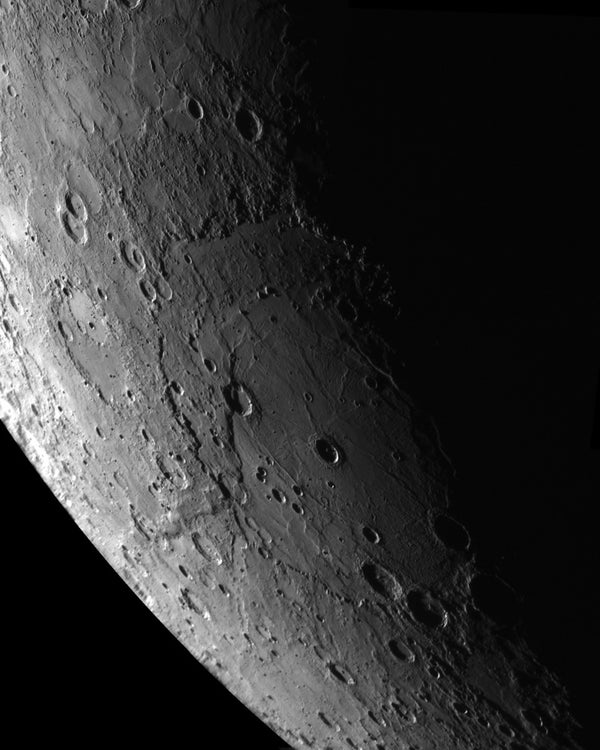
In October, the MESSENGER spacecraft swung past Mercury, passing within 125 miles (200 kilometers) of the planet and imaging portions of its surface that had never been seen before. Mercury's proximity to the sun largely stymies Earth-based study of the planet, and the last probe to pay the planet a visit was Mariner 10 in the 1970s.
Researchers on the MESSENGER team today published a suite of findings from the October flyby in the journal Science. Among the discoveries: a massive impact crater dubbed Rembrandt (center), which spans some 700 kilometers (430 miles), covering an area comparable to the U.S. Northeast. (Click here for an image of Rembrandt overlaid on the eastern U.S. for scale.) In a news briefing today announcing the findings, MESSENGER project scientist Thomas Watters, a geologist at the Smithsonian Institution's Center for Earth and Planetary Studies, called Rembrandt "one of the most exciting outcomes" of the flyby maneuver. Watters said the crater was extremely well preserved—relatively unspoiled by volcanic flows and unscarred by later impacts—and appears to be one of the youngest such basins on the planet.
MESSENGER (short for MErcury Surface, Space ENvironment, GEochemistry and Ranging) was launched five years ago and is progressing toward a 2011 insertion into Mercury's orbit through a series of trajectory-altering flybys of Mercury, Venus and Earth. The probe's third and final flyby of Mercury will take place in September.
