
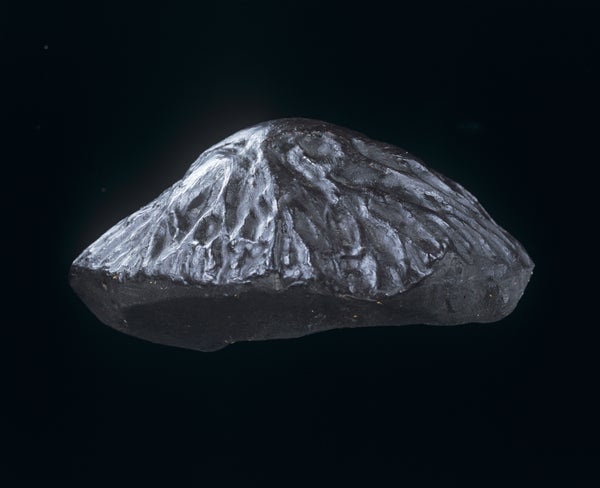
A woman in Canada narrowly missed being struck by a meteorite that crashed through her roof and landed on her pillow.
Ruth Hamilton, a resident of Golden, British Columbia, was asleep in her bed on the night of Oct. 3 when she was jolted awake by an explosive bang, as something plummeted through the roof and showered her with debris, Hamilton told Victoria News on Oct. 8.
She jumped out of bed and turned on the light, discovering a rock lying nestled between her pillows, right next to the spot where her head had been moments earlier. The object was about the size of a fist and weighed about 2.8 pounds (1.3 kilograms), The New York Times reported on Thursday (Oct. 14).
On supporting science journalism
If you're enjoying this article, consider supporting our award-winning journalism by subscribing. By purchasing a subscription you are helping to ensure the future of impactful stories about the discoveries and ideas shaping our world today.
Hamilton promptly called 911; a police officer arrived on the scene and investigated the debris, then checked with a local construction company to see if they had set off any explosions at a highway site in the nearby Kicking Horse Canyon, Victoria News reported.
A construction company representative said that no blasting had occurred that night, but they mentioned seeing “a bright light in the sky that had exploded and caused some booms,” Hamilton told Victoria News. Hamilton then realized that the object on her pillow—a greyish, melon-size boulder—was likely a rock from space, according to the Canadian Broadcasting Company (CBC).
Each year, thousands of fast-moving space rocks survive their fiery passage through Earth’s atmosphere to strike the planet’s surface as meteorites, though most of these cosmic projectiles go unnoticed and undiscovered, according to Live Science’s sister site Space.com. And very few people in recorded history are as close to a meteorite at the moment of impact as Hamilton was.
One famous example is Ann Hodges of Sylacauga, Alabama, who was struck by a falling meteorite on Nov. 30, 1954. Like Hamilton, Hodges was also asleep in her home when the meteorite came calling. But whereas Hamilton escaped her event unscathed, Hodges wasn’t so lucky. Hodges’ meteorite was about the size of a softball and weighed about 8.5 pounds (3.8 kg), and it struck her after rebounding off a radio console, causing a sizable bruise on her side, Space.com reported in 2019.
Though Hamilton was uninjured by her close call, the experience still left her shaken, she told the CBC.
“You’re sound asleep, safe, you think, in your bed, and you can get taken out by a meteorite, apparently,” Hamilton said. She plans to send the meteorite to scientists in the Department of Physics and Astronomy at Western University in London, Ontario, for analysis, but she would like to keep the rock once the researchers’ investigation is done, the CBC reported.
Copyright 2021 LiveScience, a Future company. All rights reserved. This material may not be published, broadcast, rewritten or redistributed.