
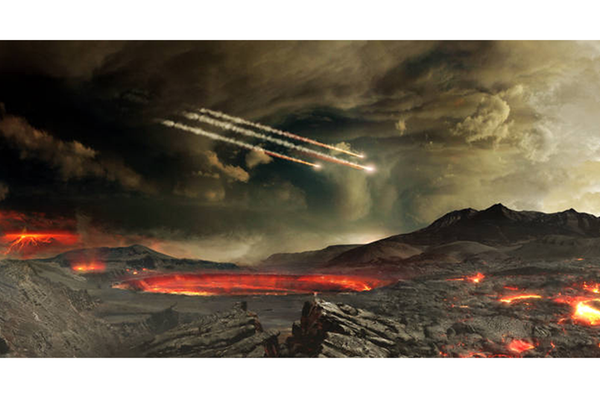
Scientists think rocks from space may be responsible for the very oldest rocks on Earth.
That’s according to new research published today (Aug. 13), which argues that meteorite bombardment is the most likely way to explain the temperature and pressure conditions under which 4.02-billion-year-old Canadian rocks formed.
“We believe that these rocks may be the only surviving remnants of a barrage of extraterrestrial impacts which characterized the first 600 million years of Earth’s history,” lead study author Tim Johnson, a geologist at Curtin University in Perth, Australia, said in a statement released by the hosts of the Goldschmidt conference being held Aug. 12 through 17 in Boston, where the research is being presented.
On supporting science journalism
If you're enjoying this article, consider supporting our award-winning journalism by subscribing. By purchasing a subscription you are helping to ensure the future of impactful stories about the discoveries and ideas shaping our world today.
The team of researchers studied a type of rock called Idiwhaa gneiss, which is more than 4 billion years old, found in northwest Canada and the oldest large swath of rock on Earth. Although scientists have identified some grains of even older rocks, those grains are so tiny they’re practically microscopic.
Specifically, the team looked at the chemical composition of those rocks and modeled what conditions rocks with that recipe could have formed under. The magic combination seemed to be temperatures of up to 1,650 degrees Fahrenheit (900 degrees Celsius) partnered with low pressures.
That’s a tricky combination to find under normal circumstances, the researchers said. Usually, hotter temperatures require traveling deeper into the earth, but pressures there are higher. The team found, however, that meteorites could solve that conundrum.
That’s because when meteorites were common, in the early days of Earth, the impacts could have raised temperatures enough to melt rocks in the very top of the crust—just the first 1.8 miles (3 kilometers) or so—without the rocks experiencing high pressures.
Most of the rocks produced during that time have fallen back into the Earth’s interior through plate tectonics, melting away its identifiable characteristics. But the Idiwhaa rocks remain, where they were named by the local Tlicho people long before scientists came to analyze them.
The research is described in a paper published today in the journal Nature Geoscience.
Copyright 2018 SPACE.com, a Purch company. All rights reserved. This material may not be published, broadcast, rewritten or redistributed.