
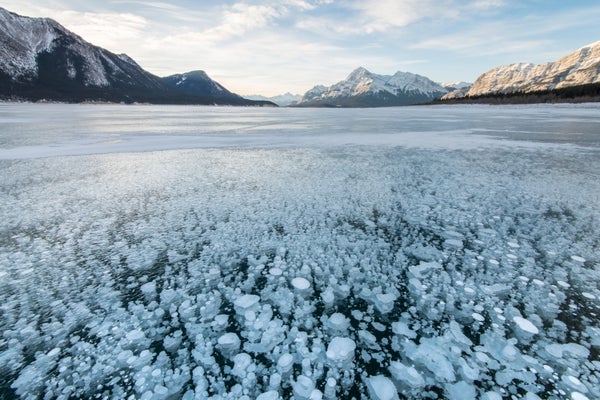
In 1776 Italian physicist Alessandro Volta discovered something bubbling up among the reeds at the marshy end of a mountain lake. It turned out to be methane, a potent greenhouse gas produced by microbes living in the lake's sediments. According to the latest estimates, lakes and reservoirs account for 10 to 20 percent of global methane emissions, and scientists expect their contribution to rise because of climate change and nutrient runoff.
Methane is also a fuel, however—as Volta learned when he set it on fire. It is, in fact, the primary component of natural gas. And a recent study in Environmental Science & Technology suggests methane in freshwater may represent an overlooked energy source.
The authors propose extracting some of the gas from lakebeds by separating it from water using a specialized membrane. Minerals called zeolites could then trap the methane molecules to be pumped to the surface. There are already membranes that can isolate methane from wastewater, and promising synthetic zeolites are under development, says Maciej Bartosiewicz, a biogeochemist at the Polish Academy of Sciences and lead author of the study. He envisions starting small, perhaps with mobile devices deployed in hydroelectric dam reservoirs (which often emit methane), to complement other green energy options.
On supporting science journalism
If you're enjoying this article, consider supporting our award-winning journalism by subscribing. By purchasing a subscription you are helping to ensure the future of impactful stories about the discoveries and ideas shaping our world today.
Methane-rich water has been pumped from the depths of Rwanda's Lake Kivu to supply local electricity since 2015. But that lake has exceptionally high levels of the gas, and some scientists are skeptical that it can—or should—be extracted in other settings. At lower concentrations, methane extraction is not yet cost-effective, and “the material and energy needed to harvest it are likely huge,” says David Bastviken, an environmental scientist at Linköping University in Sweden, who was not involved in the study. Bastviken also worries about potential ecological consequences.
Bartosiewicz acknowledges these concerns, including possible effects on methane-eating microbes and the rest of the food chain. But he notes that human activities have already increased methane production in many ecosystems. So removing some gas might be okay in certain locations, he says, adding that he is eager to investigate solutions: “There needs to be a step forward.”