
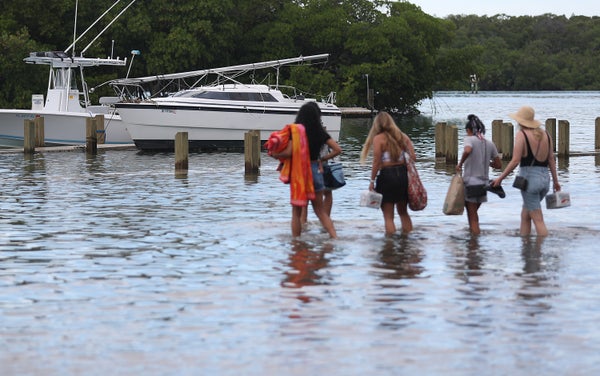
Florida’s next two decades could be more disruptive than any period in its history as climate change threatens the state’s 8,500-mile coastline and chews away at its $1 trillion economy.
New modeling by Resources for the Future, a nonpartisan economic think tank, reveals that “100-year floods” could occur every few years rather than once a century in many locations, endangering an additional 300,000 homes, 2,500 miles of roadways, 30 schools and four hospitals.
Miami will also become “the most vulnerable major coastal city in the world,” RFF said, with hundreds of billions of dollars in assets under assault from winds, storm surges, coastal flooding and sea-level rise.
On supporting science journalism
If you're enjoying this article, consider supporting our award-winning journalism by subscribing. By purchasing a subscription you are helping to ensure the future of impactful stories about the discoveries and ideas shaping our world today.
“The sheer numbers of people who will feel direct climate impacts in their lifetimes is very, very significant, and it points to why public policies are necessary right now to start reducing the risks,” said Daniel Raimi, a senior research associate at RFF and lecturer at the Gerald R. Ford School of Public Policy at the University of Michigan.
The findings, presented in a 70-page, graphics-rich report, build on work by the Climate Impact Lab, a consortium of scientists, economists and other academics working to measure the real costs of global climate change. Impact projections are based on three different climate scenarios—“moderate,” “higher” and “extreme”—associated with future greenhouse gas emissions.
The report also examines various policy prescriptions that will help reduce those risks, including carbon pricing mechanisms to help shift the United States from carbon-intensive energy and transportation fuels to cleaner alternatives.
“Addressing climate change has upfront costs,” said Raimi and co-authors Amelia Keyes and Cora Kingdon. “But failing to address climate change? Those costs are likely to be much greater and long lasting.”
While impacts from unchecked climate change will be widespread in Florida, its major cities will bear a heavier burden due to their higher populations and densities.
Miami-Dade County and the Tampa Bay region will feel some of the greatest effects from rising seas, for example, which are projected to gain between 8 and 12 inches in elevation by 2040. Nearly a half-million Floridians living less than 3 feet above current high-water levels could experience regular flooding, experts said, threatening $145 billion in real estate value.
Parts of the Florida Keys, already facing chronic inundation from king tides and modest storms, may need to be abandoned, RFF said. The Florida Panhandle, long assumed to be less vulnerable to climate warming, in fact will see some of the same impacts as other regions, Raimi said.
“Several major tourist attractions, including the Everglades, Biscayne National Park, and Miami Beach, are largely situated on land less than three feet above the high-water mark and may become permanently submerged by the end of the century,” RFF states.
The analysis also examines climate change and Florida mortality rates. Under a moderate emissions scenario, the effects of climate change could cause 3.8 more deaths per 100,000 Florida residents annually, or about 1,000 additional deaths per year by 2035.
Raimi said Florida has taken meaningful strides under Gov. Ron DeSantis (R) to prepare the state for changing conditions, but the immensity of Florida’s climate change risks will require national and even international policies to avoid the worst impacts.
He said most of the state’s greenhouse gas emissions reductions since 2000 have come from market forces, including the shift from coal to natural gas by electric utilities.
Even if carbon emissions were quickly reduced after 2020, experts say states like Florida will still see impacts from stronger hurricanes, rising seas and other changes associated with existing high levels of greenhouse gases in the atmosphere.
“Climate change is not a black-and-white situation. It’s not like an asteroid hitting the Earth,” Raimi said. “But we know we’re in for some major impacts. It’s important to know where we’re vulnerable so we can make informed decisions about possible solutions.”
Reprinted from Climatewire with permission from E&E News. E&E provides daily coverage of essential energy and environmental news at www.eenews.net.