
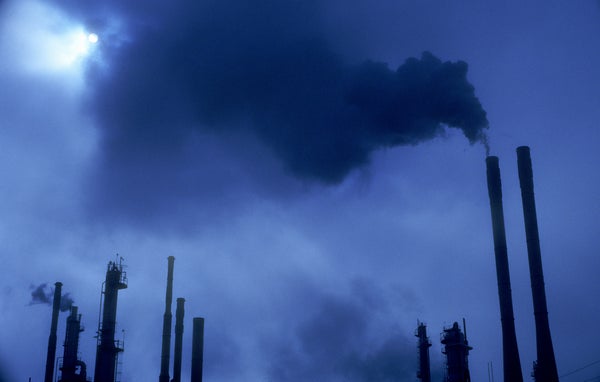
Pollution trends in the Middle East are unexpectedly declining, but for tragic reasons, a research team says. Before 2010, emissions in major cities such as Tehran, Cairo and Baghdad were rapidly trending upward, in tandem with the region’s robust economic growth. The upward trend was predicted to continue, according to the Intergovernmental Panel on Climate Change. But a team of researchers in Germany, Cyprus and Saudi Arabia, studying data from satellites that monitor emissions of nitrogen oxides, found steep drop-offs that correlated to political and economic upheavals including the start of the Syrian civil war in 2011 and the extended sanctions on Iran in 2010. Decreases in emissions are vital in combating global pollution and climate change, but the Middle East’s recent downward trend comes at a steep cost.
Although nitrogen oxides play only a small role in climate change, they have a significant impact on local health and regional weather. High levels of emissions can aggravate respiratory problems such as asthma by producing ozone, a powerful oxidizing agent, at the ground level. In the atmosphere these emissions can cause acid rain and damage the ozone layer that protects Earth from space-borne radiation.
The team’s findings, published last August in Science, could not have been predicted by standard models because those models cannot account for unexpected political events. Also, the researchers noted that short-term changes in the emissions of nitrogen oxides are difficult to detect using most pollution inventories or projections as the models they use are based on energy usage and typically address carbon dioxide emissions. Atmospheric monitoring using satellites can help detect these changes and could provide more immediate information to policymakers.
On supporting science journalism
If you're enjoying this article, consider supporting our award-winning journalism by subscribing. By purchasing a subscription you are helping to ensure the future of impactful stories about the discoveries and ideas shaping our world today.

“Abrupt recent trend changes in atmospheric nitrogen dioxide over the Middle East,” by Lelieveld et al in Science Advances, August 21, 2015. This graphic also includes more recent data provided by the authors.
Graphic by Amanda Montañez