Migrating Birds Provide Surprising Snacks for Sharks  

Meticulous work reveals the identity of sharks’ feathered prey 

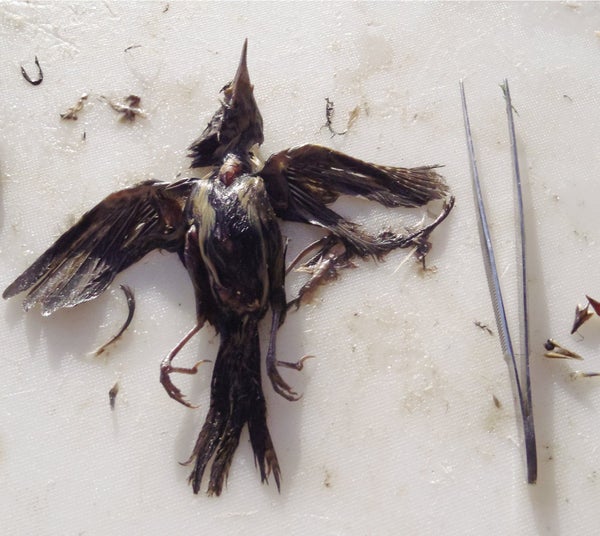
Songbird from a tiger shark's stomach

Marcus Drymon Field Museum

Join Our Community of Science Lovers!

When fisheries biologist James Drymon noticed feathers in the vomit of a tiger shark, he first assumed they belonged to some unfortunate seabird: a gull, perhaps, or a pelican. But when he and his team genetically sequenced the feathers, the results surprised them: the quills came from a land-based songbird called a brown thrasher. So what was it doing in a tiger shark's stomach in the Gulf of Mexico?

Drymon, a researcher at Mississippi State University's Coastal Research and Extension Center, and his colleagues sorted through the stomach contents of 105 juvenile tiger sharks between 2010 and 2018. Nearly 40 percent had recently feasted on birds that hail from dry land. In all, the scientists counted 11 terrestrial bird species showing up on the sharks' menu. The results were published online in May in Ecology.

Researchers have known since the 1960s that sharks sometimes eat songbirds, “but what was interesting to us was the prevalence” of the behavior, Drymon says. “This is something that happens every year in a high number” of sharks.


On supporting science journalism

If you're enjoying this article, consider supporting our award-winning journalism by subscribing. By purchasing a subscription you are helping to ensure the future of impactful stories about the discoveries and ideas shaping our world today.


Every fall and spring, songbirds undertake dramatic migrations across the Gulf of Mexico. If bad weather comes along, they can be forced to land on the water—which is effectively a death sentence. “The estimate for the number of migrants that die because of storm-related events is in the billions,” Drymon says. He suspects that sharks have long taken advantage of this twice-yearly nutritional bounty raining down from the skies, but scientists have only recently had the genetic tools to confirm this by identifying partially digested feathers.

The results underscore how interconnected marine and terrestrial ecosystems can be, says University of Miami marine ecologist Neil Hammerschlag, who was not involved in the study: “It shows how opportunistic and amazingly generalist these sharks are.”

Jason G. Goldman is a science journalist based in Los Angeles. He has written about animal behavior, wildlife biology, conservation, and ecology for Scientific American, Los Angeles magazine, the Washington Post, the Guardian, the BBC, Conservation magazine, and elsewhere. He contributes to Scientific American's "60-Second Science" podcast, and is co-editor of Science Blogging: The Essential Guide (Yale University Press). He enjoys sharing his wildlife knowledge on television and on the radio, and often speaks to the public about wildlife and science communication.

More by Jason G. Goldman
Scientific American Magazine Vol 321 Issue 3This article was published with the title “A Migrating Snack” in Scientific American Magazine Vol. 321 No. 3 (), p. 15
doi:10.1038/scientificamerican0919-15b

It’s Time to Stand Up for Science

If you enjoyed this article, I’d like to ask for your support. Scientific American has served as an advocate for science and industry for 180 years, and right now may be the most critical moment in that two-century history.

I’ve been a Scientific American subscriber since I was 12 years old, and it helped shape the way I look at the world. SciAm always educates and delights me, and inspires a sense of awe for our vast, beautiful universe. I hope it does that for you, too.

If you subscribe to Scientific American, you help ensure that our coverage is centered on meaningful research and discovery; that we have the resources to report on the decisions that threaten labs across the U.S.; and that we support both budding and working scientists at a time when the value of science itself too often goes unrecognized.

In return, you get essential news, captivating podcasts, brilliant infographics, can't-miss newsletters, must-watch videos, challenging games, and the science world's best writing and reporting. You can even gift someone a subscription.

There has never been a more important time for us to stand up and show why science matters. I hope you’ll support us in that mission.

Thank you,

David M. Ewalt, Editor in Chief, Scientific American

Subscribe