
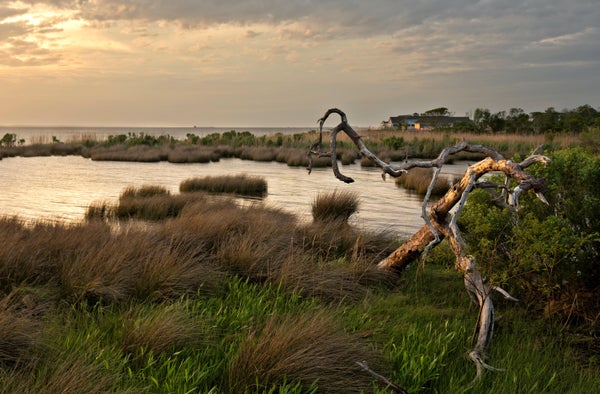
A long stretch of salt marsh that hugs the East Coast from North Carolina to Florida is being targeted for conservation under a unique agreement reached by state and federal officials, including several Pentagon leaders concerned about climate change.
The goal in trying to protect more than 1 million acres of salt marsh is to maintain coastal resilience to climate change and protect inland property, including several major military bases that are jeopardized by rising sea levels and intensifying coastal storms. Salt marshes protect coastal and inland areas from flooding, storm surge and erosion, and have other benefits such as providing coastal habitat for birds and fish, which are vital to local economies.
The conservation project will be overseen by a group called the Southeast Regional Partnership for Planning and Sustainability (SERPPAS), which was created in 2005 to bring together state and federal officials to sustain local natural resources and prevent encroachment around military facilities.
On supporting science journalism
If you're enjoying this article, consider supporting our award-winning journalism by subscribing. By purchasing a subscription you are helping to ensure the future of impactful stories about the discoveries and ideas shaping our world today.
The group, a voluntary partnership with no legislative powers, agreed last week to develop a plan to protect salt marshes in the Southeast after being urged to do so by environmental groups.
“The endorsement of so many of the most powerful and influential stakeholders in the region to protect this vast habitat together was a leap forward for conservation and the climate,” said Joseph Gordon, who directs the Pew Charitable Trusts’ efforts to protect marine life on the East Coast.
Salt marsh runs along most of the coast of South Carolina and Georgia and is present on parts of the coast of northern Florida and southern North Carolina.
“The hope is to have a plan that leads to greater protections and allows stakeholders such as the military, states [and] private land owners to more effectively protect and conserve this resource in the future,” Gordon said in an interview yesterday.
Pew was among 24 groups including conservation organizations and hunting and fishing advocates that signed an April 9 letter urging SERPPAS to develop a conservation plan for the salt marsh—“a first line of defense” for coastal communities and military installations.
Development and climate-driven sea-level rise “threaten to drown this vital habitat, impacting coastal communities, businesses, military installations, and fish and wildlife alike,” the letter warned.
The Defense Department will be heavily involved in the conservation work as part of its effort to protect the numerous military installations near the Southeast coast—including Hunter Army Airfield in Georgia and the Marine Corps training facility at Parris Island, S.C.—from potential damage caused by climate change.
SERPPAS’s co-chairs are Richard Kidd, the deputy assistant secretary of Defense for environment and energy resilience, and Chuck Sykes of the Alabama Department of Conservation and Natural Resources.
In a statement, Kidd said the agreement to protect salt marsh along the Southeast coast will “improve the resilience of our coastal installations as we adapt to rising sea levels and other associated risks of climate change.”
Seven of the principals in charge of SERPPAS are military officials. Other principals work for state agencies in Alabama, Florida, Georgia, North Carolina and South Carolina or for federal agencies such as EPA, NOAA and the U.S. Geological Survey.
The military’s influence in conservation has been noted in Florida by environmental groups that helped protect land around the Camp Blanding Joint Training Center near Jacksonville to provide both wildlife habitat and a buffer for military testing and training.
“We have seen firsthand how the military involvement in the conservation of lands can help protect the military mission while advancing shared protection goals,” Jim McCarthy, president of the North Florida Land Trust, said in a statement last week.
Reprinted from E&E News with permission from POLITICO, LLC. Copyright 2021. E&E News provides essential news for energy and environment professionals.