Milky Way Census Shows Stars Take Varied Paths

The Gaia satellite is making the most detailed and complete map of the stars in our galaxy

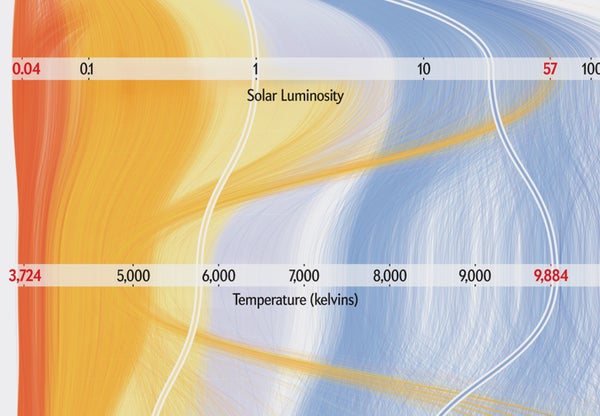
Detail of a chart that groups 85,000 stars by spectral type, age, solar luminosity, temperature, solar mass and solar radius.

Nadieh Bremer

Join Our Community of Science Lovers!


On supporting science journalism

If you're enjoying this article, consider supporting our award-winning journalism by subscribing. By purchasing a subscription you are helping to ensure the future of impactful stories about the discoveries and ideas shaping our world today.


After launching to space in 2013, the European Space Agency’s Gaia telescope has been spinning in full circles every six hours, mapping all the stars it can see in every direction. Scientists recently released a new catalog of the mission’s latest data, which includes measurements of the chemical compositions, temperatures, colors, masses, ages and speeds of almost two billion stars in the Milky Way. These data reveal typical trends for stars: The massive stars tend to be hot and young. Because they don’t live for long, the older massive stars will have died out by now. The smaller stars with lower masses live much longer, so we find them at every age, and they tend to be cooler and redder.

Gaia’s observations help astronomers piece together our galaxy’s history and understand how it compares with others across the universe. “We are sitting inside the Milky Way,” says Timo Prusti, Gaia’s project scientist. “It’s like a forest: you see lots of trees, but you don’t know what the forest looks like because you are inside. With Gaia, we are trying to measure all the trees so we can figure out what it looks like.”

Credit: Nadieh Bremer (graphic); “Gaia Data Release 3: A Golden Sample of Astrophysical Parameters,” by Gaia Collaboration, arXiv, 2022 (data)

Clara Moskowitz is chief of reporters at Scientific American, where she covers astronomy, space, physics and mathematics. She has been at Scientific American for more than a decade; previously she worked at Space.com. Moskowitz has reported live from rocket launches, space shuttle liftoffs and landings, suborbital spaceflight training, mountaintop observatories, and more. She has a bachelor’s degree in astronomy and physics from Wesleyan University and a graduate degree in science communication from the University of California, Santa Cruz.

More by Clara Moskowitz
Scientific American Magazine Vol 327 Issue 6This article was published with the title “Milky Way Census” in Scientific American Magazine Vol. 327 No. 6 (), p. 80
doi:10.1038/scientificamerican1222-80

It’s Time to Stand Up for Science

If you enjoyed this article, I’d like to ask for your support. Scientific American has served as an advocate for science and industry for 180 years, and right now may be the most critical moment in that two-century history.

I’ve been a Scientific American subscriber since I was 12 years old, and it helped shape the way I look at the world. SciAm always educates and delights me, and inspires a sense of awe for our vast, beautiful universe. I hope it does that for you, too.

If you subscribe to Scientific American, you help ensure that our coverage is centered on meaningful research and discovery; that we have the resources to report on the decisions that threaten labs across the U.S.; and that we support both budding and working scientists at a time when the value of science itself too often goes unrecognized.

In return, you get essential news, captivating podcasts, brilliant infographics, can't-miss newsletters, must-watch videos, challenging games, and the science world's best writing and reporting. You can even gift someone a subscription.

There has never been a more important time for us to stand up and show why science matters. I hope you’ll support us in that mission.

Thank you,

David M. Ewalt, Editor in Chief, Scientific American

Subscribe