
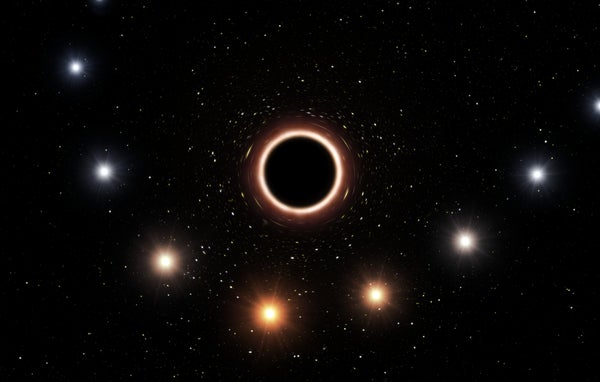
Astronomers have caught the giant black hole at our galaxy’s centre stretching the light emitted by an orbiting star—nearly three decades after they first starting tracking the star. The long-sought phenomenon, known as gravitational redshift, was predicted by Einstein’s general theory of relativity, but until now it had never been spotted in the environs of a black hole.
“It’s another big step in getting closer to understanding the black hole,” says Heino Falcke, an astronomer at Radboud University in Nijmegen, the Netherlands, who was not involved in the research. “This is just amazing, to be able to see these effects.”
A team led by Reinhard Genzel, of the Max Planck Institute for Extraterrestrial Physics in Garching, Germany, announced the discovery in July at a press conference and reported the results in Astronomy & Astrophysics. The group includes scientists from universities and research institutions in Germany, France, Portugal, Switzerland, the Netherlands, the United States and Ireland.
On supporting science journalism
If you're enjoying this article, consider supporting our award-winning journalism by subscribing. By purchasing a subscription you are helping to ensure the future of impactful stories about the discoveries and ideas shaping our world today.
Genzel and his colleagues have tracked the journey of this star, known as S2, since the early 1990s. Using telescopes at the European Southern Observatory in Chile, the scientists watch it as it travels in an elliptical orbit around the black hole, which lies 26,000 light-years from Earth in the constellation Sagittarius. With a mass of 4 million times the Sun, the black hole generates the strongest gravitational field in the Milky Way. That makes it an ideal place to hunt for relativistic effects.
On May 18 this year, S2 passed as close as it ever does to the black hole. The researchers pointed instruments including GRAVITY, an instrument called an interferometer that combines light from four 8-meter telescopes and became operational in 2016. “With our measurements the door is wide open to black-hole physics,” says team member Frank Eisenhauer, an astronomer at the Max Planck institute.
GRAVITY measured S2’s movement across the sky; at its fastest, the star whizzed along at more than 7,600 kilometres a second, or nearly 3 percent the speed of light. Meanwhile, a different instrument studied how fast S2 moved towards and away from Earth as it swung past the black hole. Combining the observations allowed Genzel’s team to detect the star’s gravitational redshift—its light being stretched to longer wavelengths by the black hole’s immense gravitational pull, which is consistent with the predictions of general relativity.
“What we measured cannot be described by Newton any more,” says Odele Straub, an astrophysicist at the Paris Observatory. Future observations of S2 might confirm other Einstein predictions, such as how the spinning black hole drags space-time around with it.
“Their data look beautiful,” says Andrea Ghez, an astronomer at the University of California, Los Angeles, who leads a competing team that uses the Keck telescopes in Hawaii to measure the star’s path around the galactic centre.
It takes 16 years for S2 to make a complete orbit around the black hole, so both groups have been eagerly awaiting this year’s close passage. But Ghez says that her team plans to wait until later in the year to publish their results. Of three crucial events happening in 2018, only two have transpired so far.
In April, S2 experienced its maximum velocity in the line of sight from Earth. In May, it made that closest approach to the galactic centre. And in late August and early September, it will experience the minimum velocity in the line of sight from Earth. “It’s taken us 20 years to get to this moment,” Ghez says. “We’re going to wait until the end of the passage, until the star will be done with whatever it’s going to do.”
S2 has already begun slowing down, in the direction of travel as seen from Earth, as it transitions towards the third event. And both the US and European teams are watching it closely. “We’re in the thick of it,” says Ghez. “It’s super-exciting.”
This article is reproduced with permission and was first published on July 26, 2018.