
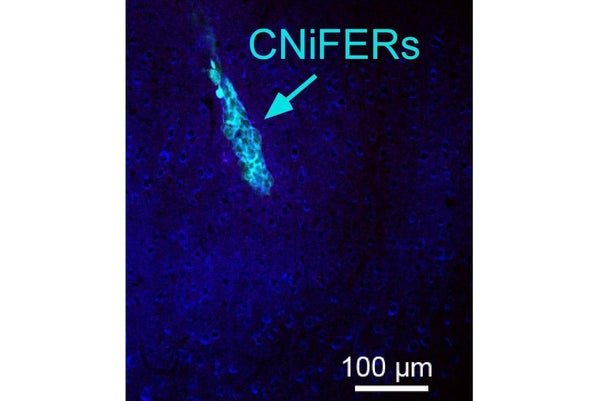
When a single neuron fires, it is an isolated chemical blip. When many fire together, they form a thought. How the brain bridges the gap between these two tiers of neural activity remains a great mystery, but a new kind of technology is edging us closer to solving it.
The glowing splash of cyan in the photo above comes from a type of biosensor that can detect the release of very small amounts of neurotransmitters, the signaling molecules that brain cells use to communicate. These sensors, called CNiFERs (pronounced “sniffers”), for cell-based neurotransmitter fluorescent engineered reporters, are enabling scientists to examine the brain in action and up close.
This newfound ability, developed as part of the White House BRAIN Initiative, could further our understanding of how brain function arises from the complex interplay of individual neurons, including how complex behaviors like addiction develop. Neuroscientist Paul Slesinger at Icahn School of Medicine at Mount Sinai, one of the senior researchers who spearheaded this research, presented the sensors Monday at the American Chemical Society’s 252nd National Meeting & Exposition.
On supporting science journalism
If you're enjoying this article, consider supporting our award-winning journalism by subscribing. By purchasing a subscription you are helping to ensure the future of impactful stories about the discoveries and ideas shaping our world today.
Current technologies have proved either too broad or too specific to track how tiny amounts of neurotransmitters in and around many cells might contribute to the transmission of a thought. Scientists have used functional magnetic resonance imaging to look at blood flow as a surrogate for brain activity over fairly long periods of time or have employed tracers to follow the release of a particular neurotransmitter from a small set of neurons for a few seconds. But CNiFERs make for a happy medium; they allow researchers to monitor multiple neurotransmitters in many cells over significant periods of time.
When a CNiFER comes in contact with the neurotransmitter it is designed to detect, it fluoresces. Using a tiny sensor implanted in the brain, scientists can then measure how much light the CNiFER emits, and from that infer the amount of neurotransmitter present. Because they comprise several interlocking parts, CNiFERs are highly versatile, forming a “plug-and-play system,” Slesinger says. Different sections of the sensor can be swapped out to detect individual neurotransmitters. Prior technology had trouble distinguishing between similar molecules, such as dopamine and norepinephrine, but CNiFERs do not.
The sensors are being tested in animals to examine particular brain processes. Slesinger and his colleagues have used CNiFERs to look more closely at a classic psychological phenomenon: Pavlovian conditioning. Just as Pavlov trained his dog to salivate at the sound of a dinner bell, Slesinger and his team trained mice to associate an audio cue with a food reward. At the beginning of the experiment, the mice experienced a release of dopamine and norepinephrine when they received a sugar cube. As the animals became conditioned to associate the audio cue with the sugar, however, the neurotransmitter release occurred earlier, eventually coinciding with the audio cue rather than the actual reward.
Mouse studies might be a far cry from the kind of human impact that neuroscience ultimately strives toward—better treatments for Parkinson’s patients or concussion sufferers, for example—but this is where it all begins. Slesinger is especially interested in using CNiFERs to study addiction. A more nuanced understanding of how addiction develops in mouse brains could help identify novel targets to combat addiction in people.