
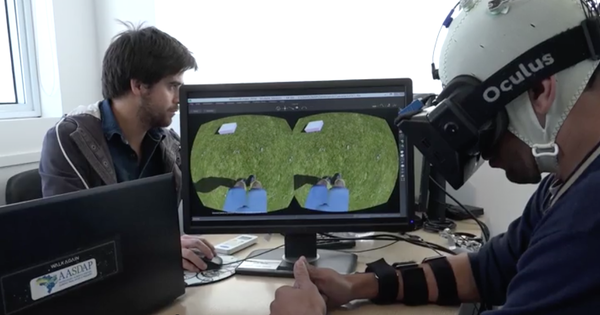
Patients paralyzed by a spinal cord injury can face a grim and grueling recovery process—one in which regaining function is far from a sure thing. But a new study published last week in Scientific Reports may provide some hope to those suffering from paraplegia. Using what are called brain–machine interfaces (BMIs)—essentially cyborg connections between prosthetic devices and the nervous system—researchers for the first time were able to show that the process of learning to use a BMI-controlled device can trigger significant neurological recovery in patients with chronic spinal cord injuries. Although the researchers did expect their patients to make progress in learning to walk by using the device—a BMI-controlled exoskeleton designed to move their legs—recovery of sensation and unassisted movement were totally unexpected. Scientific AmericanMIND spoke with neuroprosthetic pioneer, founder of Duke University’s Center for Neuroengineering and lead study author Miguel A. L. Nicolelis about the findings and the field in general.
How does the brain–machine interface actually work? We start by using EEG—or electroencephalography; in other words, using an electrode cap on the scalp to record [brain] activity from the outside. Initially we asked patients to think about walking, but at first there was no signal change since their brains had essentially forgotten what it’s like to have legs. Then we said, “Instead of thinking about moving your legs, think that you are moving your arms.” Here we started seeing EEG activity, which was used as the initial signal to start training them in a virtual reality environment. They were asked to control the movements of an avatar of themselves walking around a soccer field by first thinking about moving their arms and then, gradually, their legs.
Once they mastered this, we outfitted them with static robotic [legs] to move from just controlling the movements of an avatar to controlling an exoskeleton and actually trying to walk. We detected brain signals showing that patients were trying to walk and could send these signals to exoskeletons that then do the mechanical work for them, which allow the patient to move. But I think the most important innovation here is that for the first time we could also generate very rich tactile feedback from the exoskeleton back to the patient so they would have a sensation of walking. They could feel when the robotic feet touched the ground.
On supporting science journalism
If you're enjoying this article, consider supporting our award-winning journalism by subscribing. By purchasing a subscription you are helping to ensure the future of impactful stories about the discoveries and ideas shaping our world today.
The trick is providing these sensations to the arms of the patients, which—given that these were paraplegic patients, not quadriplegics [paralyzed in all limbs]—were functioning and sensing normally. The patients, of course, look at their legs while trying to walk, and since visual signals override tactile signals most of the time, their brains converted signals to their arms and [they] began feeling sensations that seemed to be coming from their paralyzed legs. It’s a phantom limb kind of sensation. They would say, “I’m feeling my legs moving and I’m walking by myself” even though they were inside of an exoskeleton and the robot was moving them. So really, we’re fooling the brain by using the skin as a transducer.
What improvements did you see in patients who participated in your brain–machine interface program?
All the patients we looked at eventually reported feeling sensations below the level of their spinal injury. We also started seeing movement return. They were beginning to voluntarily control several muscles for the first time since their injuries, which in some patients was over 10 years. We also noticed that the patients started showing improvements in control of bowel movements and the bladder, which can be impaired in spinal cord injuries and can result in serious infections. So they were also experiencing visceral improvements.
As they improved—using scalp recordings—we saw an expansion of the representation of the lower limbs in the cortex, which had disappeared after their injuries. At the end of a year, half of the patients had been reclassified from complete paralysis to partial paralysis. Since the study ended, all seven patients who have remained with us have been reclassified to partial paralysis.
Has this kind of result been seen before?
To our knowledge, this is the first study showing that brain–machine interfaces can trigger partial neurological recovery in paraplegic patients. So we are very surprised and, of course, very happy. Prior to this these interfaces were thought of as potential assistive technologies, not as therapies.
How long did patients undergo therapy before seeing effects? And how frequent were the sessions?
The times varied for each patient but most underwent therapy for upwards of a year. And we started seeing improvements at about seven months. We looked at eight patients in total, all of whom underwent about two one-hour training sessions a week.
Are there any safety concerns with the technology?
No, we don’t think so. We haven’t seen any side effects.
Do any other interventions help with recovery in paraplegic patients?
Not that we are aware of—at least at this level. There’s an occasional report of people improving. And by stimulating the spinal cord [using epidural electrical stimulation], doctors have been able to induce movements in some patients—but the moment they turn the stimulation off the patients stop moving and show no long-term recovery.
What’s next?
We got permission to continue following the patients in this study and we also recruited a second cohort of patients to try to run a series of placebo controlled studies. So we plan to continue assessing the evolution and extent of sensory and motor recovery over time. I really think this is going to be big. We’re retraining people’s brains to reacquire the notion of walking. It took us 15 years, but we got here.