
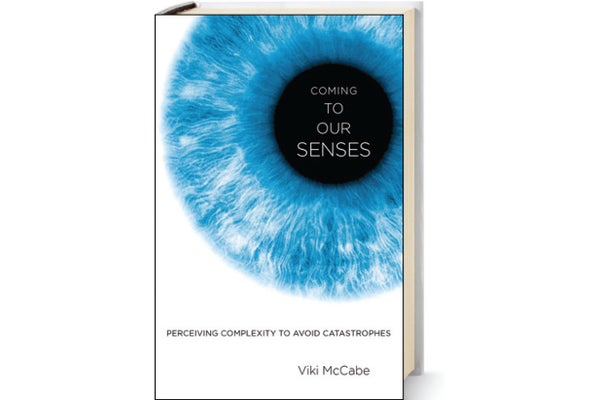
Coming to Our Senses: Perceiving Complexity to Avoid Catastrophes
by Viki McCabe
Oxford University Press, 2014
Sometimes our theories about the world take on a life of their own. We take them so seriously that we ignore the properties of our environment that generated those theories in the first place.
A cognitive psychologist and visiting scholar at the University of California, Los Angeles, McCabe believes this tendency often gets out of hand, contributing to many of modern society's tragedies and ills: the Great Recession of 2008, for example, driven by a focus on derivatives rather than by the actual value of commodities, or the death of more than 1,000 people in Hurricane Katrina, caused by faulty theories about the effectiveness of levees instead of observations about how complex natural drainage systems work.
On supporting science journalism
If you're enjoying this article, consider supporting our award-winning journalism by subscribing. By purchasing a subscription you are helping to ensure the future of impactful stories about the discoveries and ideas shaping our world today.
McCabe's take on this phenomenon is unique and fresh. Drawing on both scientific research and news stories, she demonstrates three things: first, that our mental life is often out of touch with the physical reality around us; second, that we sometimes make better judgments about the complexities in our environment when we rely on intuitions—hunches informed by unconscious perceptions—instead of analytical thinking; and third, that people are complex, dynamic systems nested in a world of complex, dynamic systems.
The book is excellent at reminding us of the importance of complex systems in virtually every aspect of our lives. Even when our intentions are good, McCabe notes, a simple intervention—removing the wolves from Yellowstone National Park to make cattle safer—can destroy an entire ecosystem, resulting in dead trees, erosion and flooding.
At times, though, McCabe goes too far in her defense of intuition. When she tells us, for example, the story of a woman who had a bad feeling about an old man and young girl in a convenience store, she speculates that the woman's unease was an unconscious reaction to the irregular “yoked movements” of the pair. Sure enough, the man turned out to be a kidnapper and pedophile, but this is not evidence for the power of intuition; it is just an anecdote. Extensive research on intuition yields a complex picture. Generally speaking, analytical thinking seems to be every bit as valuable as intuition. Each may serve us well, depending on the circumstances.
As a researcher, I also found myself bothered at times by what seemed to be an emotional undertone in the book. McCabe often conveys the impression that our failure to pay closer attention to the complex systems of nature is unjust—that our reliance on theory causes millions of people to suffer and even threatens the very existence of the human race. Yet our cogitations also help many people to survive and prosper.
Although McCabe has produced a fascinating book, she misses a fundamental point: namely that theories, including her own, become part of complex systems; they are not separate from them. In a sense, theories are just more data, helping us make the best decisions we can.