
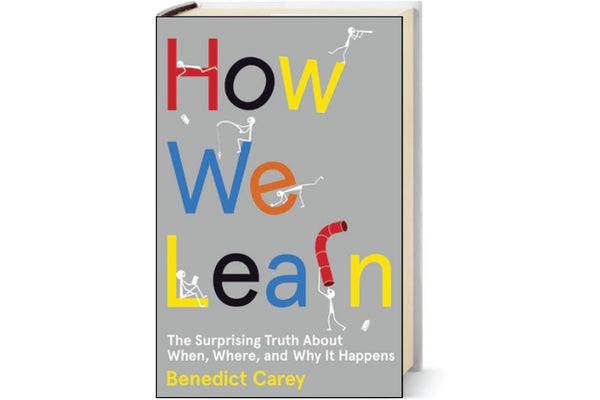
How We Learn: The Surprising Truth about When, Where, and Why It Happens
by Benedict Carey
Random House, 2014
How We Learn is Carey's gift to guilt-ridden slackers everywhere. In the book, the award-winning New York Times science journalist dismantles the “proper” study habits drilled into students from primary school—minimize distractions, adopt a study ritual, find a quiet space—and replaces them with something that could be called responsible loafing.
Slacking is built into our nature—and for good reason. Carey takes the reader through study after study, uncovering the benefits of napping, daydreaming, background noise, forgetting and walking away: precisely the habits that are usually assumed to be impediments to learning, not its drivers.
On supporting science journalism
If you're enjoying this article, consider supporting our award-winning journalism by subscribing. By purchasing a subscription you are helping to ensure the future of impactful stories about the discoveries and ideas shaping our world today.
To build his case, Carey first introduces the reader to the neurological underpinnings of learning and memory—describing how the cellular network that holds a memory expands and grows stronger every time that memory is recalled and how forgetting is actually a useful mechanism by which our brain prunes out irrelevant information.
With that foundation, he moves on to memory-enhancing techniques and problem-solving skills, pulling together research on how the brain works into quick tips people can use to learn better and more efficiently. Instead of always studying in the same spot, for example, Carey recommends changing locations, which maximizes the number of associations tied to a certain memory and makes it easier to access come test time. He quashes concern over the distracting influence of social media, explaining how a short Facebook break can actually help you solve a stubborn problem by clearing your head and letting you return to the task with fresh eyes. In the final section, he also covers tricks you can use to boost learning subconsciously—revealing, for instance, how important sleep is to the process (hint: very).
Thanks to Carey's knack for storytelling, the book is as entertaining as it is functional. He amusingly recounts the sometimes kooky experiments that pioneering learning and memory researchers devised to explore how the mind works in an era devoid of modern brain-imaging technology, often using themselves or their families as test subjects. In a particularly famous experiment, German psychologist Karl Duncker made up puzzles using common household objects—including a matchbox, candles and thumbtacks—to tease out the circumstances that give rise to insight.
Unsurprisingly, Carey incorporates the learning strategies he describes into the book, which can be tedious—such as when he reviews concepts he just covered or doles out homework assignments. Even so, after reading, I felt I had absorbed and retained more information in this book than others of similar heft, so perhaps he is on to something.
Of course, Carey does not suggest blowing off work entirely—effort is always required for success. But what he offers is a way to make it as painless, efficient and gratifying as possible. In the end, How We Learn is more than a new approach to learning; it is a guide to making the most out of life. Who wouldn't be interested in that?
