
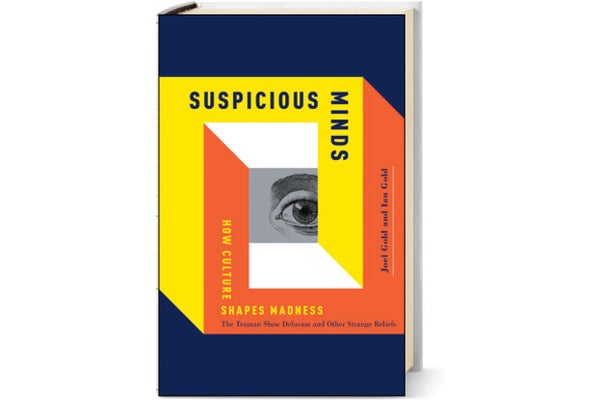
Suspicious Minds: How Culture Shapes Madness
by Joel Gold and Ian Gold
Simon & Schuster, 2014
In 2003 “Albert” came to Bellevue Hospital's psychiatric emergency room. A 26-year-old assembly worker, he was convinced that his life was the focal point of a television show. He entered Bellevue after a fracas at the United Nations, where he had gone to demand asylum from his televised life.
For psychiatrist Joel Gold, Albert was the first in a series of patients convinced they lived their entire existence on TV, circumstances that proved eerily similar to those depicted in the 1998 film The Truman Show. These patients prompted Joel Gold and his brother, philosopher Ian Gold, to investigate how culture influences the content of delusional thinking. Suspicious Minds is the result of that research, which led them to lay out a theory for understanding psychosis through a social lens.
On supporting science journalism
If you're enjoying this article, consider supporting our award-winning journalism by subscribing. By purchasing a subscription you are helping to ensure the future of impactful stories about the discoveries and ideas shaping our world today.
The Golds begin by reviewing the history and theories of madness, dwelling in particular on hints of interpersonal deficits in people with delusions. For example, individuals with psychoses struggle to understand other people's mental states. Schizophrenia, too, seems to have a social component: immigrants who face discrimination and urbanites in very populous cities face heightened risk of the disorder.
Drawing on such evidence, the Golds hypothesize that everyone employs a “suspicion system” to read and respond to social situations, but some individuals experience delusions when their personal threat detector breaks down. For some, this system may be faulty from birth or broken through severe social strain. Individuals with amygdala deficits may struggle to decode facial expressions such as fear or anger. Delusions then occur when a person tries to make sense of inappropriately perceived social threats; for example, a delusion of grandeur is a way for someone who feels lost in a crowd to puff up his or her status.
The authors stud their carefully compiled evidence with historical and current case studies. These are the most poignant passages in the book, including an overstressed 24-year-old medical student who abandons her studies to try to raise the dead at Ground Zero and a devoted husband whose 30-year marriage collapses when a series of strokes leaves him obsessively jealous. The Golds suggest that the content of these delusions reflects the reigning zeitgeist—whereas a schizophrenic Englishman in the 19th century feared French spies and pneumatic machinery, a contemporary patient fears the NSA and iPads.
The importance placed on time-sensitive cultural influence may be the weakest argument presented here, eclipsed by the more intriguing ideas about suspicion and immediate social context. Altogether, though, the authors offer a fascinating and intimate portrait of psychosis. Rather than reducing mental illness to mutations and misfiring neurotransmitters, Suspicious Minds reminds readers that otherwise healthy people can experience delusional impulses driven by insecurity or stress. In the Golds' conception of psychosis, the line between mental health and illness is very fine indeed.