
The organs of speech are the same for all people, or so linguists have typically assumed. But it turns out that may not be true—in fact, what you eat can change how you talk.
The conventional wisdom held in the field of historical linguistics is the vocal apparatus of human beings has remained fixed since the emergence of Homo sapiens some 200,000 years ago. As a consequence, all humans, both ancient and modern peoples, possess the same basic capacity to produce speech sounds. But recent evidence from several studies in paleoanthropology has upended these assumptions by suggesting the way we eat can actually alter jaw anatomy. And according to research just published in Science, the consequences for the way we speak have been profound.
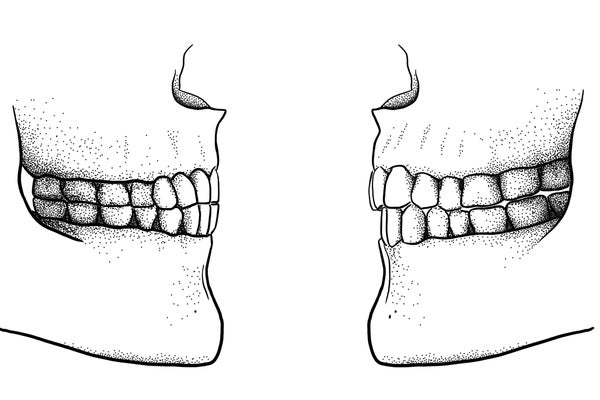
The lead authors of the study, Damián Blasi and Steven Moran of the University of Zurich along with colleagues, became intrigued by fossil evidence showing the form of the human jaw had changed in our species’s relatively recent evolutionary past. Amonghunter–gatherers of the Paleolithic period, adults’ upper and lower teeth aligned to form a flat line, the top ones resting directly on the bottom set. Scientists attribute that configuration primarily to tooth wear brought about by chewing hard foods, such as unmilled grains or seeds. With the advent of agriculture in the post-Neolithic period, however, the upper teeth protruded over and above the lower teeth, presumably due to the reduced challenge of consuming soft foods such as porridge and cheese.
On supporting science journalism
If you're enjoying this article, consider supporting our award-winning journalism by subscribing. By purchasing a subscription you are helping to ensure the future of impactful stories about the discoveries and ideas shaping our world today.
These findings suggest not only that the cultural shift that gave rise to agriculture occasioned a shift in human anatomy. It also appears to have introduced new speech sounds known as labiodentals—the “f” and “v,” for instance. Blasi and Moran’s study furnishes evidence that adopting the signature foodstuffs of sedentary society ultimately allowed us to mouth words like “farro” and “verbalize” by raising the lower lip and bringing it into contact with the upper teeth. Their research group conducted biomechanical simulations of this movement using two different virtual jaws to calculate the muscular effort involved. Their results showed, compared with the protruding bites, the flat bite configurations required substantially more effort to produce a labiodental.
Linguists had already established that articulatory effort can affect the fate of a phoneme, so Blasi and Moran’s team speculated that labiodentals would have been less likely to emerge among any population with flat bites, such as Paleolithic humans, or even modern humans who eat harder foods. To test this hypothesis, they analyzed databases of the world’s consonants and showed contemporary hunter–gatherer languages contain only a fraction of the labiodental sounds that food-producer languages do. Of course, food preparation techniques are merely a stand-in for actual bite configurations. To make the link more explicit, the researchers separately analyzed hunter–gatherer societies in Greenland, southern Africa and Australia, where flat bites have been explicitly documented. In line with their hypothesis, results turned up relatively few languages with labiodentals among these populations. When one of these sounds appeared, it was usually borrowed from other languages.
As a final piece of support for their argument, Blasi and Moran’s team examined sound changes in Indo-European languages over time. They used a nontraditional technique called stochastic character mapping, which calculates the numerical probability a sound existed in a language at a particular point in time. Results showed labiodental sounds were extremely unlikely in almost all branches of Indo-European, until anytime from 6,000 to 4,000 years ago. After that period, which coincides with the introduction of soft foods, the probability of these sounds showed a notable increase.
The take-home message: “we can’t take for granted that spoken languages sound the same today as they did in the distant past,” Moran says. “This means in particular that the set of speech sounds we use has not necessarily remained stable since the emergence of our species, but rather the immense diversity of speech sounds that we find today is the product of a complex interplay of factors involving biological change and cultural evolution.”
Not everyone is convinced of the arguments put forth in the new study. Israel Hershkovitz of Tel Aviv University points out many factors besides tooth wear can affect bite configurations. Also, tooth wear occurs gradually and does not fully affect bite dynamics until adulthood. Given the relatively short life expectancy of prehistoric hunter–gatherers, he says, it seems unlikely this anatomical trait could have affected language evolution.
To other observers, Blasi and Moran’s study, along with others in recent years, reflects a paradigm shift in historical linguistics. “This paper revives an idea that linguists probably abandoned out of a natural apprehension—the danger of verging on ideas that could be interpreted as racist—which arises whenever anatomical differences between populations are proposed to play a role in any aspect of language or cognition,” says Andrew Garrett of the University of California, Berkeley, who was not involved in the study. “Today, however, there is clear evidence that individual anatomical, physiological and perceptual differences do play some role in linguistic differences.”