
It’s 1820, and the whaleship Essex is in the Pacific Ocean, on a voyage to hunt sperm whales and collect their oil. The days are long, work is hard, it's hot, land is nowhere to be seen, and food is, well, unpleasant to say the least.
For the crew of this voyage, success depends on catching, killing and extracting as much oil as possible—remember, this is 39 years before petroleum is discovered in Pennsylvania in 1859. The Essex is not alone, hundreds of vessels during the late 18th and early to mid-19th century participated in this animal-based economy. Not to the betterment of sperm whales, whose numbers were seriously depleted by decades of overexploitation (today, these animals are listed as Vulnerable on the IUCN Red List).
Of course, for those of you picking up, or brushing off, the quintessential classic Moby-Dick this fall, you will likely understand the rest of this story, albeit with some historical modifications. A sperm whale of considerable proportions, the Pequod (read, the Essex), and Captain Ahab entangle in a prophetic battle that conjures images akin to Disney's Fantasia. It does not end well, for the whale, Ahab or the Pequod.
On supporting science journalism
If you're enjoying this article, consider supporting our award-winning journalism by subscribing. By purchasing a subscription you are helping to ensure the future of impactful stories about the discoveries and ideas shaping our world today.
Herman Melville's 1851 novel, a dramatic, fictionalized version of events that occurred on the real-life Essex is considered a foundational piece of American literature. But what is the truth on which that literature was constructed? What Melville fails to write in his 600-plus page novel is that the survivors of the Essex, the 19th-century whaling industry and the source of inspiration for his classic all owe their success—and their lives—to Galápagos tortoises.
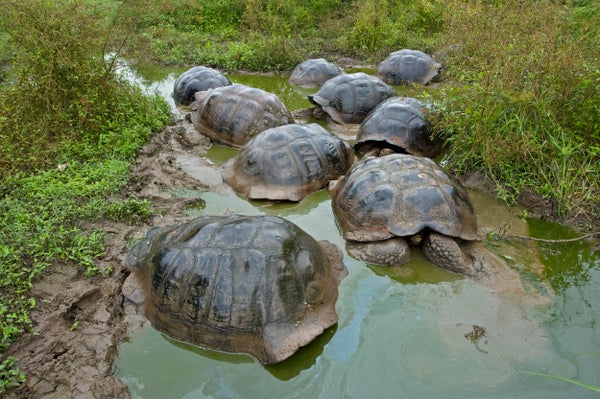
When the Essex ventured into the Pacific and round Cape Horn, she stopped on Floreana and Española Islands in the Galápagos. This was all too common for whaleships during this era. Tortoises can live long periods without food and water; they are also large, apparently tasty and easy to transport. Perfect food for gastronomically deprived and scurvy-ridden whalers.
Luckily, a surviving manuscript from the Essex cabin boy, Thomas Nickerson, helps describe what happened next. On Floreana Island the crew accomplished two tasks: they collected 100 tortoises to consume during their long days at sea (in addition to 180 tortoises collected from Española); and a member of the crew lit the island on fire, as a prank. The Floreana tortoise likely held on a few years more, but eventually this species went extinct, no thanks to the Essex and her crew. Nickerson noted that when the whaleship departed, they could still see the “blazing fire” in the distance, and when he revisited the island several years later, the blackened desolation was still visible.
While this record is disturbing and speaks to the wanton destruction earlier generations of humanity brought to the Galápagos, the true horror comes after the infamous sperm whale rammed the Essex and sent her to the depths. The few survivors lucky enough to be in boats quickly grabbed any provisions they could from the sinking whaleship. Most importantly, they “saved” a dozen Galápagos tortoises from the wreck.
Then, before descending into eventual cannibalism, the crew killed, butchered and consumed every bit and piece of meat (and blood) available from those helpless animals. In one meal, which Nathaniel Philbrick describes, the crew held down a tortoise, cut it open, drank its blood, then started a fire in the tortoise’s shell and cooked it all—including the entrails.
So, let’s think this through: Melville is inspired to write Moby-Dick after meeting the former Essex captain and reading survivors stories; the survivors of the Essex owe a least a portion of their lives to the flesh of Galápagos tortoises; but at the same time, the tortoises themselves owe nothing to the whalers who both destroyed their habitat and intensively exploited them for food. It’s possible to state that if the Essex had never collected tortoises from the Galápagos, Melville would never written Moby-Dick. It is an odd and disturbing circle of events.
I also now see why Ron Howard skipped this part in his film adaptation In the Heart of the Sea—seeing tortoises butchered and slaughtered is not very heroic or family-friendly.
In this era of animal extinctions, biodiversity loss, deregulation of the environment and anthropogenic climate change, when you read Moby-Dick, remember the history of the Galápagos tortoises. More importantly, teach this history. If we are lucky, our own species can learn from the mistakes of our ancestors and stop the industrial scale destruction of nonhuman animals. We need to remember that the only reason we have Moby-Dick is thanks to Galápagos tortoises. In many ways, it’s surprising that given the 100,000–200,000, or more, tortoises killed during the era of their exploitation, there weren’t more books, stories and acclaim created from the flesh of these iconic creatures.