
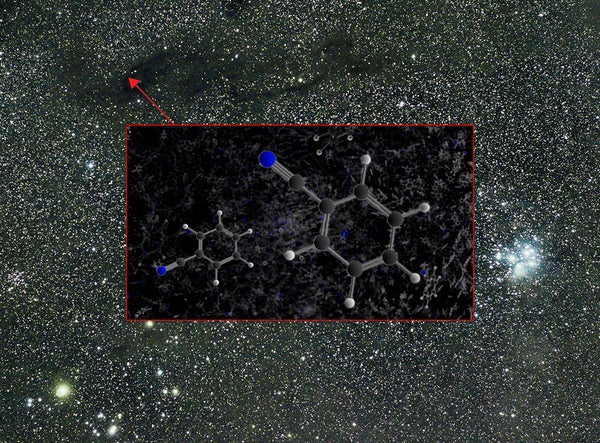
Some 18 percent of the human body’s weight is carbon. The simple element is considered the backbone of life, and is also abundant in Earth’s rocks, atmosphere and oceans. Scientists don’t know how carbon first appeared on our planet, but now astronomers have discovered a special molecule in space that could help trace this essential element back to its source.
Researchers using the Green Bank Telescope in West Virginia identified signatures of the molecule benzonitrile (C6H5CN) in a mass of gas and dust called the Taurus Molecular Cloud 1, which lies 430 light-years from Earth. The heart of benzonitrile is a six-carbon hexagon called benzene—a structure that puts the compound in the “aromatic” class of molecules and makes benzonitrile a building block for a group called polycyclic aromatic hydrocarbons (PAHs), which contain lots of carbon hexagons. Scientists think PAHs are incredibly common in the universe, yet astronomers have not identified a single such molecule in space. This new observation is the closest they have come. “This study shows you have the first steps of PAHs, these first rings of benzene,” says Xander Tielens, an astrochemist at Leiden University in the Netherlands who was not involved in the research. “Then you can grow to bigger and bigger species. Understanding where these molecules come from and understanding what role they play in the inventory of space is a key goal of astronomy.” The findings were published today in Science and presented at a meeting of the American Astronomical Society in Washington, D.C.
The study may be a step toward explaining where planets like Earth got their carbon. The element starts out in the cores of stars, where it is a product of nuclear fusion. But when stars die and eject their materials into space, what happens to it? Scientists think the largest fraction—between 10 to 20 percent—becomes PAHs, which can form whenever a warm carbon-containing gas cools down. Eventually, do those PAHs find their way into the protoplanetary disks around stars that form planets and asteroids? “This is the first step in starting to unlock those questions,” says Ryan Fortenberry, an astrochemist at Georgia Southern University who was not part of the study. “We need carbon to make planets, to make life, to do interesting chemistry. We have this hypothesis about where the carbon is tied up, but we’ve had no way to confirm it. [Benzonitrile] allows us to start looking in the right places.”
On supporting science journalism
If you're enjoying this article, consider supporting our award-winning journalism by subscribing. By purchasing a subscription you are helping to ensure the future of impactful stories about the discoveries and ideas shaping our world today.
If PAHs hold the ingredients for the seeds of life, they are also its enemy. These molecules are carcinogenic and commonly found on Earth in car exhaust and smokestack emissions. The reason they are so bad for our health is because they are hard to break apart—their central carbon ring is extremely stable and resistant to reactions, making them difficult for our bodies to degrade. But this stability also means they can hang out for extended periods in the harsh environment of space, only occasionally being cracked open by extremely high–energy photons. Astronomers have seen generic light patterns that suggest some kinds of PAHs abound in our galaxy and others. Yet individual PAH molecules are very hard to tell apart from one another, and researchers have never been able to determine which specific ones are out there.
To spot benzonitrile, astronomers led by chemist Brett McGuire of the National Radio Astronomy Observatory in Virginia observed the Taurus cloud for more than 35 hours in total, combining all the light collected into a single dataset that finally showed the molecular signature. Every chemical species has characteristic wavelengths of light that it emits or absorbs, which depend on its precise configuration. Benzonitrile made its presence known by emitting photons in the radio range of the electromagnetic spectrum as the molecule tumbled end over end in space. “How spread out the molecule’s mass is and where the atoms are change how fast the molecule is spinning,” McGuire says. “As the molecule sheds or gains angular momentum, it gives off light.”
The researchers were able to identify benzonitrile because it is asymmetric: on one edge of its carbon hexagon hangs a carbon–nitrogen pair. This distinguishing feature makes it easier to find than full PAHs. The latter tend to be symmetric, so their shape does not change as they spin—therefore they do not give off a recognizable pattern of light as they rotate. The team hopes to use the same technique to identify benzonitrile in other cosmic locations soon. “By observing it in this source for the first time, we now understand that it’s out there,” McGuire says, “and we have ideas of other places we can go look for it.”