
SEATTLE—Protein engineer Aaron Chevalier has a hunch that origami—on a smaller scale—could be the future of drug design.
So he and a team here at the University of Washington spend their days designing intricately folded chains of amino acids to create molecules that do not exist in nature. The goal: Create a protein that might bind to a virus like the flu and stop it from infecting cells. Or one that could break up gluten, effectively taming gluten allergies.
“You could imagine a future where we’re able to design an essentially unlimited number of new proteins that basically are the drugs of the future, the vaccines of the future,” said David Baker, a biochemist who leads the university’s Institute for Protein Design.
On supporting science journalism
If you're enjoying this article, consider supporting our award-winning journalism by subscribing. By purchasing a subscription you are helping to ensure the future of impactful stories about the discoveries and ideas shaping our world today.
Naturally, caveats abound.
For one, it’s unclear if our immune systems will accept new proteins they’ve never seen before. They could cause new allergies. The body could reject them. Or they could turn out not to work in real life, even if they look good on a computer screen. And in practical terms, it will likely be years before any of these newly designed proteins make their way to our medicine cabinets.
“Like with any drug, you always have to experimentally test it before you stick it into a person,” Baker said.
Yang Zhang, a professor of biological chemistry at the University of Michigan, is also engineering proteins. He said Baker’s work is promising, but turning a theoretical protein into a functional therapeutic will take time because the protein will effectively be interacting with an entire system, not just the target it is intended for.
“It is a very complicated process for a drug. You need to consider not only these interactions, you also need to consider the side effects, or the interaction with the environment, and many other protein pathways,” he said.
On a summer afternoon, Chevalier demonstrated the principle of protein folding to a group of students visiting the lab by folding and unfolding an origami cup. That’s hard, he said. But designing a new molecule to fight disease is even harder.
“It’s not just figuring out folding a cup. It’s like you want the cup to be stiff, or hold a lot of water, or it needs to last a long time,” said Chevalier.
Proteins are the workhorses of the human body; there are millions out there that are evolution-approved and running our bodies with Swiss watch precision. Protein engineering is about designing them to work together in novel ways to battle sickness, said Don Hilvert, a professor of organic chemistry at ETH Zurich in Switzerland who collaborates with Baker.
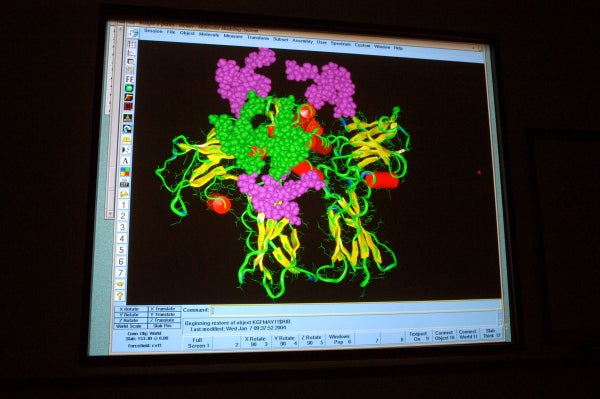
In the past, scientists used their knowledge of thermodynamics and biochemistry, with a dash of intuition and trial and error, to find potential therapeutics. Now, Baker’s team can ask a software program to come up with a protein that is a certain size and shape, has a certain chemistry, and will work in a certain way. And their software, Rosetta, will give them scores of candidates that they can build and test.
Computing all the combinations
In the computer lab half of the IPD, protein engineers in T-shirts hunch over monitors, examining designs and coding improvements to Rosetta. The software analyzes scores of combinations of amino acids to find ones that meet the specified size, shape, and chemical parameters—and that would be possible to build, meaning they don’t defy the laws of physics.
“It’s literally a computer fantasy,” said Neil King, an IPD investigator.
Rosetta can come up with lots of molecules fast. When Baker and his colleagues published an article in Science in July about one of their designs—a “molecular cage” that would help deliver drugs—they didn’t publish just one blueprint. They published 10 versions. They’re pretty sure none exist in nature.
Once Rosetta is done designing the proteins, the scientists test them out. They order the requisite DNA sequence online and then pop it into bacteria or yeast that will use those genetic instructions to build a novel protein.
Chevalier designs proteins based on antibodies that he thinks will fight flu better by locking the virus out of our cells. Rosetta gave him some candidate structures. His next challenge is showing his designs will work.
“If you think about antibodies, they evolved to be circulating in your bloodstream,” he said. “They aren’t necessarily evolved to be packaged and stored without the need for refrigeration. They aren’t designed to be produced in large scale, to be soluble, to be concentrate-able.”
Chevalier hopes that by starting from scratch, he can make a single protein with all of those characteristics—which could in theory become the basis for a low-cost, shelf-stable drug.
While he hasn’t managed that yet, Chevalier has tested one highly-stable protein in mice. That protein stopped the flu, as reported in a paper published this February. Work in the lab is funded mostly by government and non-profit agencies, but they do get funding from Takeda Pharmaceuticals. Now Chevalier and Baker are launching a biotech company called Virvio for further development.
Republished with permission from STAT. This article originally appeared on August 12, 2016