
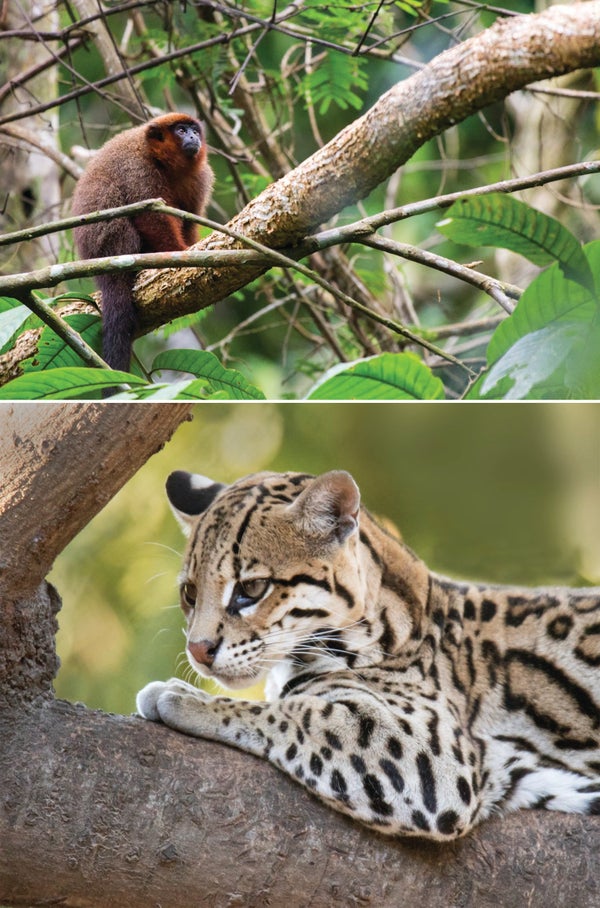
Anthropologist Dara Adams was following a troop of six saki monkeys in Peru’s Amazon rain forest, when out of nowhere they began shrieking, hooting and barking loudly. Suddenly, sleek and black as night, a small wildcat called a jaguarundi descended the trunk of a Brazil nut tree, leaped to the forest floor and ran off into the jungle.
Many animals use alarm calls to warn others in their species about a predator. But that does not entirely explain what Adams saw—because the monkeys continued calling even after the entire group became aware of the threat. A more tantalizing possibility is that the monkeys were addressing the cat itself, blowing its cover and warning it to call off the hunt.
This idea, which scientists call the “pursuit deterrence hypothesis,” has been proposed in studies of birds, fish and mammals. But the vast majority of studies focus on the calling prey animal, rather than the impacts of those calls on the predators, Adams says. So she and her team from the Ohio State University decided to radio-collar two ocelots, another type of petite cat found in the Peruvian Amazon. While tracking the cats’ movements, Adams and her colleagues used an unobtrusive loudspeaker to broadcast recorded alarm calls from titi and saki monkeys, two species ocelots prey on. They also played other types of social calls made by the monkeys.
On supporting science journalism
If you're enjoying this article, consider supporting our award-winning journalism by subscribing. By purchasing a subscription you are helping to ensure the future of impactful stories about the discoveries and ideas shaping our world today.
The alarm calls proved an effective deterrent, prompting the ocelots to move away from the loudspeaker. When the cats heard the other types of calls, they either stayed still or moved in some random direction—but never as far away as when they heard the alarm ones, the team reported last November in Animal Behaviour. “Our study provides the first experimental evidence to show that wild ambush predators in natural conditions are deterred by prey alarm calls,” Adams says.
Dan Blumstein, a biologist at the University of California, Los Angeles, who was not involved in the study, agrees that the findings suggest these monkeys’ calls serve to warn off the cats. But he wonders, “Are they moving away out of fear of getting attacked by the monkeys? Or are they moving away because they know the game is up?”