
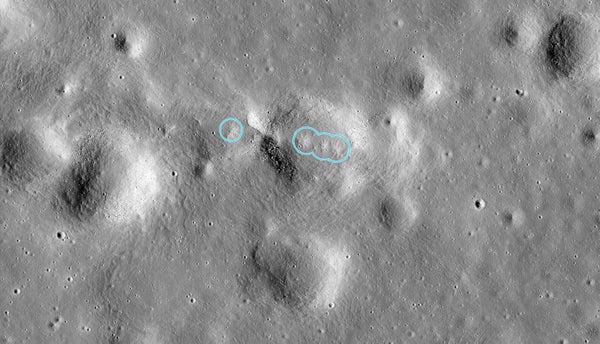
Lava plains and volcanic residue on the moon’s surface point to the orb’s fiery past. What’s below, though, remains mostly a mystery. But in a study in the Planetary Science Journal, researchers describe an odd surface feature that supports the presence of underground caves termed subsurface voids.
Each so-called spider formation consists of multiple gullies (the spider’s “legs”), which seem to have formed when lunar soil flowed into a central indentation about 10 meters wide (the spider’s “body”). The researchers spotted the first four spiders hiding almost imperceptibly in a photograph from the powerful cameras on NASA’s Lunar Reconnaissance Orbiter (LRO): “The spider legs are almost at the edge of resolution,” says the study’s lead author, Mikhail A. Kreslavsky, a planetary scientist at the University of California, Santa Cruz.
Once they knew what to look for, the scientists found several more spiders, all in Mare Tranquillitatis—a region with a turbulent volcanic past. Brown University planetary geoscientist and study co-author James W. Head says the relatively low lunar gravity likely allowed big bubbles of gas to form in magma, leaving behind subsurface voids. If these voids’ ceilings collapsed because of seismic activity, the authors say, inward-flowing surface material would have created the distinctive spider shape.
On supporting science journalism
If you're enjoying this article, consider supporting our award-winning journalism by subscribing. By purchasing a subscription you are helping to ensure the future of impactful stories about the discoveries and ideas shaping our world today.
In an earlier study, LRO detected a void extending under a large pit in Mare Tranquillitatis, and researchers have speculated that some of the moon’s roughly 300 other known pits have spacious caves below.
The study authors suspect many more spiders once existed and were erased. “There are still lots of micrometeorites that hit the moon’s surface,” says Nicolle Zellner, a planetary scientist and physicist at Albion College in Michigan, who also studies the lunar surface. “The upper meter of material is churned by the bombardment.”
LRO project scientist Noah Petro of NASA’s Goddard Space Flight Center says the spiders’ proximity to other signs of ground disturbances in volcanic deposits called irregular mare patches, and the possibility that spiders might have once appeared near pits, could suggest the voids are larger than thought or that they’re connected underground. “Maybe voids are far more extensive than we previously assumed,” he adds.
Because today’s spiders likely formed within the relatively recent geological past, they serve as a warning for future explorers that, in certain places on the moon, dangerous caverns may still lurk below the brittle surface.