
Eleven more U.S. airports plan to adopt a new way of landing planes that reduces both emissions and noise — all by having incoming planes turn off their engines and glide down to the tarmac like a paraglider.
The Federal Aviation Administration announced Monday that planes heading to Orlando, Fla.; Kansas City, Mo.; Omaha, Neb.; Nebraska's Offutt Air Force Base; Reno, Nev.; and six airports in South Florida soon would make idle descents to runways. It's a method called “Optimized Profile Descent,” and more than 60 U.S. airports already have it in place.
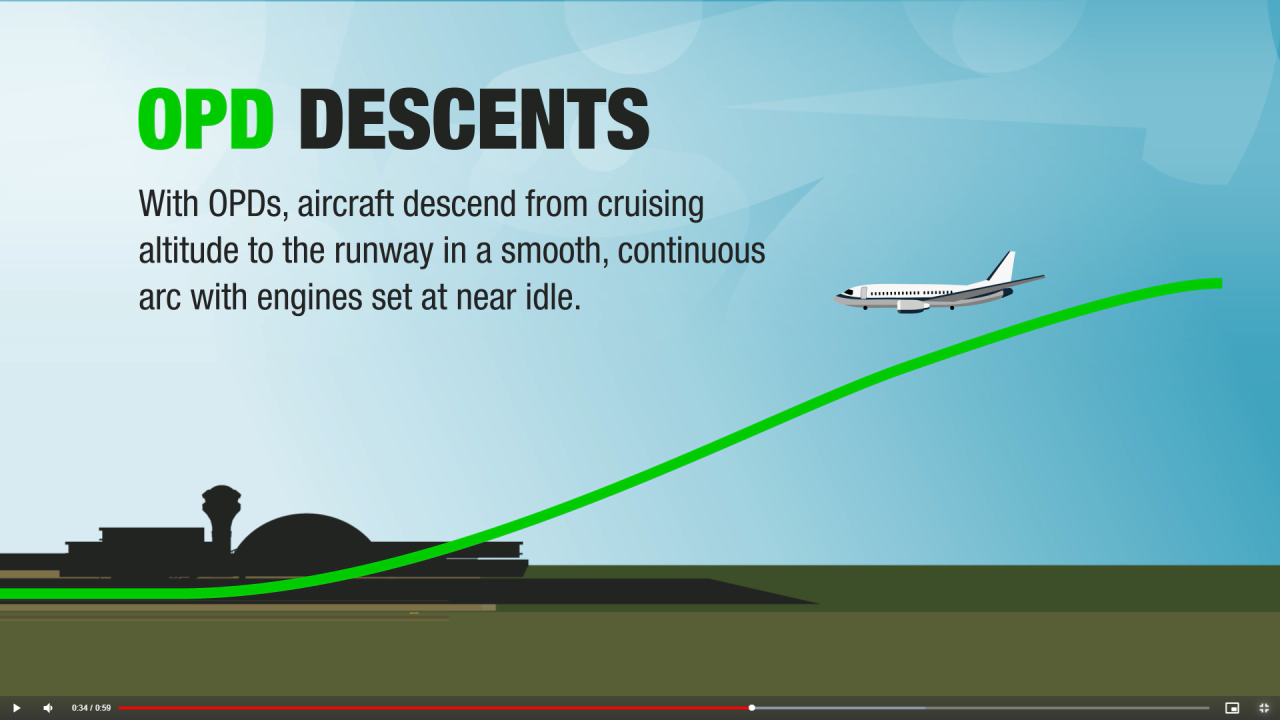
Traditionally, airplanes have made “staircase descents,” in which air traffic controllers direct pilots to lower altitudes in several intermediate steps before a complete landing to avoid collision in the busy airspace.
On supporting science journalism
If you're enjoying this article, consider supporting our award-winning journalism by subscribing. By purchasing a subscription you are helping to ensure the future of impactful stories about the discoveries and ideas shaping our world today.
The new way of landing — by allowing planes to remain longer in cruise altitude and avoid burning fuel during staircase descents — not only would cut carbon emissions but also would lower noise levels.
Airlines would save 90,000 gallons of fuel on average and reduce emissions by 27,000 tons annually, which is equivalent to the amount of fuel used by 62 Boeing 737 flights between New York and Cleveland — or the annual carbon emissions of more than 1,600 average Americans combined.
“Everybody's at idle for the entire descent, burning the minimum fuel, making the minimum noise and creating the minimum emission,” said John-Paul Clarke, an aerospace engineering and engineering mechanics professor at the University of Texas, Austin. “So it's a win, win, win and a win.”
Such fuel-efficient landing had not been possible in many of the nation’s busiest airports because of safety concerns. Without a robust model that calculates descent speed and altitude of different airplanes with varying size and shape, it was too dangerous to let them glide down to a tarmac.
“Everybody knew from the beginning of time that if I cruise, wait until the last minute and do idle descent, it is going to burn less amount of fuel,” Clarke said. “The problem is that when you have 50 airplanes coming into an airport, doing that is really tough.”
What changed are those very models that Clarke and his colleagues built in the early 2000s. The approach was first applied to Los Angeles International Airport, and it is now used in 64 airports around the country, including those in Atlanta, Denver, Houston, Miami, Seattle, the District of Columbia and Las Vegas, allowing aircraft to draw smooth, continuous arcs while landing.
The difficulty of arranging the busy American airspace, however, makes it harder for more airports to adopt Optimized Profile Descent, Clarke said. Because any given airspace is like “Swiss cheese” with aircraft passing below and above them, adopting this new approach to landing means adjusting and redesigning dozens, if not hundreds, of flight routes.
The change is still happening, albeit slowly.
“We are investing across the entire system to provide passengers with the best travel experience,” said acting FAA Administrator Billy Nolen in a statement. "The era of choppy descents is coming to an end, providing a smoother landing and saving fuel in the process."