
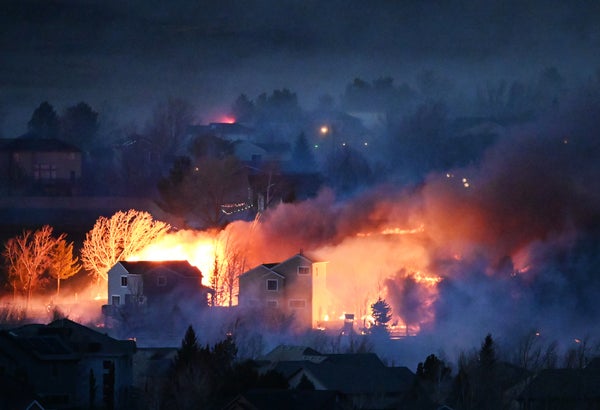
Wildfires are growing bigger, more frequent and more destructive as the climate warms. Yet Americans are still choosing to migrate into fire-prone areas across the country, a new study finds.
It’s not completely clear what’s motivating people to relocate into danger zones. The pull of large cities with strong economies, dramatic landscapes and other natural amenities may be part of the draw. And the risk of getting caught in a blaze just isn’t enough to deter relocators.
That’s not all. The study also finds that people also tend to migrate into large cities with particularly hot summers, even as temperatures are rising across the country.
On supporting science journalism
If you're enjoying this article, consider supporting our award-winning journalism by subscribing. By purchasing a subscription you are helping to ensure the future of impactful stories about the discoveries and ideas shaping our world today.
The findings suggest that U.S. migration patterns are “increasing the number of people in harm’s way,” the researchers write.
The study, published recently in the journal Frontiers in Human Dynamics, looks at human migration patterns across the United States. It examines the factors that motivate people to move into certain areas—and the factors that put them off.
Research suggests a variety of factors may influence people who are looking to make a move. Socioeconomic variables, such as population density and cost of living, are important. Natural amenities, including nearby forests and bodies of water, also make a difference.
On the other hand, natural hazards—such as the possibility of extreme weather and natural disasters—can be a deterrent.
The new study used U.S. census data to compile migration statistics at the county level between 2010 and 2020. The researchers also compiled data on natural amenities, natural hazards and socioeconomic factors around the country. They then used statistical models to analyze the data.
The findings confirm that people are attracted to large metropolitan areas with strong economies. At the same time, people who move into more rural areas tend to be drawn toward natural features such as bodies of water and forested landscapes.
But the study also finds that while these kinds of amenities may pull people in, other risks don’t always push them away.
All other factors equal, the researchers found, people tended to migrate away from certain natural hazards and toward others. People generally moved away from areas with frequent hurricanes and heat waves. But they moved into areas with higher risks of wildfires.
And although people moved away from areas prone to heat waves, they still tended to move into places with generally warm year-round climates—including cities with especially hot summers.
The findings raise a red flag about recent migration patterns, the researchers suggest.
“Both wildfire and heat are, first of all dangerous—they can affect people’s health and well-being and homes,” said lead study author Mahalia Clark, a graduate research fellow at the University of Vermont. “But they’re both hazards that are supposed to get worse with climate change.”
The study has some important caveats. There are some important variables it didn’t account for, such as the cost of housing—a factor that can have a major influence on where people choose to relocate. In future research, delving into housing costs and the income levels of migrating households may better explain why people are choosing to move into dangerous fire zones, Clark suggested.
In some cases, it may be that people simply aren’t well educated about the risks, she added. The study suggests that people are moving into wildfire-prone areas across the country—not just in the Western states, where the dangers are well known.
“I think for wildfires in particular, people … tend to think of it as something that affects the West,” she said. “But it really can also affect large areas of the South and parts of the Midwest. So when people are moving to a new area or buying a house, they might be totally unaware that this is something they should think about.”
The findings suggest that policymakers should consider ways to better protect residents from natural hazards, Clark said.
At the same time, she added, people should factor in extreme weather and natural disasters when considering a move.
“I think it’s a good takeaway for people to do their research when moving and looking at houses, and look into what’s the level of wildfire risk here, what’s the level of heat or storm risk,” she said. “So I think that’s one takeaway—for people to maybe be more aware and look into these issues for themselves.”
Reprinted from E&E News with permission from POLITICO, LLC. Copyright 2022. E&E News provides essential news for energy and environment professionals.