
The African continent has a wide variety of habitat types, but savanna ecosystems cover roughly half. And where there is savanna, there is fire. “It's an important part of the ecology of the system,” says University of Liverpool ecologist James R. Probert. Burning allows grasses to dominate by keeping taller shrubs and thorn bushes from encroaching on the landscape. Loss of grasses could push out species such as wildebeest, which are famous for their spectacular annual migration.
A decade ago researchers attributed decreasing fires within Tanzania's Serengeti National Park to the recovery of wildebeest herds following an epidemic of rinderpest, a viral disease. When millions of wildebeest gorge on grass, they remove fuel from the landscape, making fires less frequent and less severe.
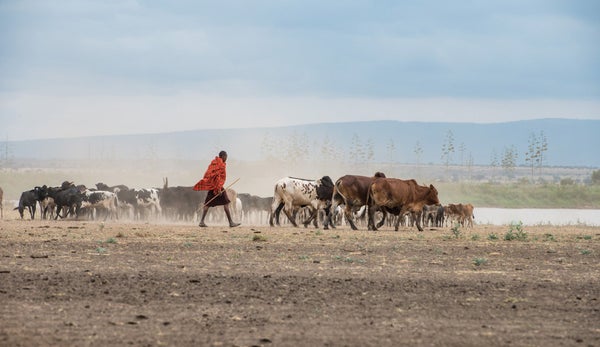
But Probert and his colleagues found that even after wildebeest populations had stabilized by the mid-1990s, fires continued to decrease in the savanna-dominated Serengeti-Mara ecosystem straddling the Tanzania-Kenya border (of which the protected Serengeti National Park is just one part). Their analysis of satellite data revealed that the region experienced a 40 percent reduction in wildfires between 2001 and 2014—coinciding with dramatic increases in livestock in the area. They reported their findings in July in the journal Global Change Biology.
On supporting science journalism
If you're enjoying this article, consider supporting our award-winning journalism by subscribing. By purchasing a subscription you are helping to ensure the future of impactful stories about the discoveries and ideas shaping our world today.
“If you have lots of herbivores eating the grass, then you have less fire. That's well known,” Probert says. “But I don't think anybody had realized the magnitude of the decline in fire and linked it to livestock before.”
“This is a really interesting pattern,” says University of Guelph biologist John Fryxell, who was not involved in the study. He cautions, however, that 15 years' worth of data is still a fairly small amount of information from which to draw definitive conclusions. “What a short-term correlation like that suggests is there's something interesting here that could provide the grounds for a deeper experimental analysis,” he adds. That research could include artificially controlling fire frequency or grazing intensity in certain areas and then monitoring the landscape's response over time.
Probert notes that some of these places are suffering from a kind of “tragedy of the commons,” with livestock using up more resources than an area can sustain. He says conservationists might consider working with pastoralists to develop a rotational grazing plan, thereby spreading the animals' impact over time and space. Studies such as Probert's continue to reveal the ways wild places like the Serengeti-Mara are inextricably linked to human activity.