
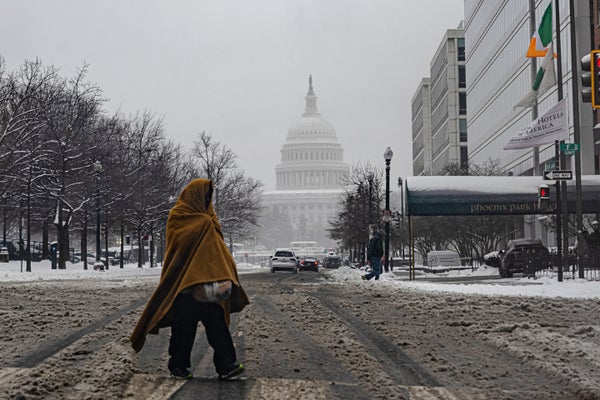
CLIMATEWIRE | Temperatures plunged across the East Coast on Tuesday after a winter storm dropped heavy snow from the Midwest to the mid-Atlantic, pointing to the dangers of winter extremes even as the planet rapidly warms.
Winter temperatures are rising overall, but research indicates that punctuations of extreme cold and snow events may be happening more often in some parts of the U.S., potentially driven by atmospheric changes linked to global warming.
At the same time, cold-related deaths in the U.S. are on the rise.
On supporting science journalism
If you're enjoying this article, consider supporting our award-winning journalism by subscribing. By purchasing a subscription you are helping to ensure the future of impactful stories about the discoveries and ideas shaping our world today.
A study published last month in the Journal of the American Medical Association found that cold-related mortalities have been trending upward for the past two decades, and especially since 2017. The research examined death statistics from the Centers for Disease Control and Prevention, concluding that older adults are especially vulnerable, as well as Native American, Alaska Native and Black communities.
The study didn’t delve into the reasons for the rise. But it suggested that a variety of factors could be at play, including increases in homelessness, substance abuse and social isolation, which may make some populations more vulnerable to winter weather.
Some experts say it’s possible that warming temperatures, themselves, could be playing a role.
People across the country are acclimating to higher temperatures, including warmer winters, said Victor Gensini, a meteorologist at Northern Illinois University, who was not involved with the new study. When extreme winter storms do come along, some people may be unprepared.
“When the cold does come, it comes with a little bit more tenacity,” he said. “It takes you a little bit more to get acclimated.”
The study, too, suggested that an increase in the frequency of winter weather extremes could be part of the story.
Winters on the whole are growing warmer across the country. The most recent National Climate Assessment, a major report published every few years by the U.S. government, noted that winters are warming twice as fast as the rest of the year in some parts of the country. Yet some studies indicate that winter storms may be worsening in some regions, like the Northeast, as the climate warms.
The Arctic is heating up faster than the rest of the planet, and rapid warming in the far North may be altering the flow of the jet stream, allowing cold air masses to blast more frequently into the midlatitudes.
The exact physical mechanisms are still a matter of debate among scientists, Gensini said.
“But we’ve uncovered some physical linkages behind how possibly a warming climate could actually create more frequent cold extremes in the midlatitudes,” he added. "There's definitely literature out there that suggests that's plausible."
Reprinted from E&E News with permission from POLITICO, LLC. Copyright 2025. E&E News provides essential news for energy and environment professionals.