Mosquitoes Will Save Us All ... from Mosquitoes

Scientists are turning the infectious bloodsuckers into allies in the global war on disease

Join Our Community of Science Lovers!


On supporting science journalism

If you're enjoying this article, consider supporting our award-winning journalism by subscribing. By purchasing a subscription you are helping to ensure the future of impactful stories about the discoveries and ideas shaping our world today.


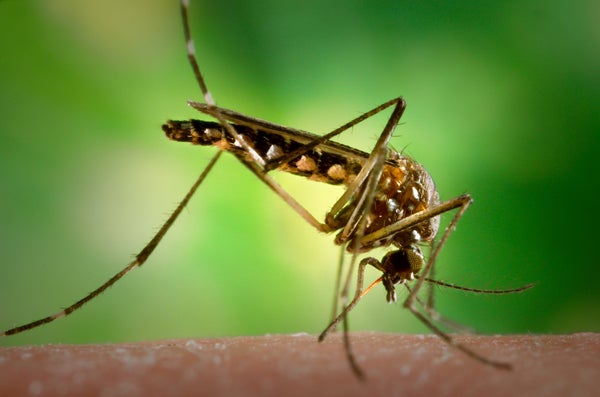
This month the first U.S. experiment to release genetically modified (GM) mosquitoes into the wild gets put to a vote in Key Haven, Fla., and the county of Monroe. If the Florida Keys Mosquito Control District then approves the trial, U.K. biotech firm Oxitec will release millions of mutant male mosquitoes that had required an antibiotic to stay alive until adulthood. These males will pass the dependency to their offspring, which will then die without access to the drug. The resulting population plummet could reduce the risk of mosquitoes spreading diseases such as dengue fever—Key Haven suffered an outbreak in 2009–2010—and the growing threat of the Zika virus.

Many in Key Haven have voiced concerns about the safety of hosting GM insects in their backyards, but outside experts say these mosquitoes would be innocuous. “There are no potential [health] risks to the Oxitec genetically modified mosquitoes approach,” says Thomas Miller, an emeritus professor of entomology at the University of California, Riverside. And although this would be a first for the U.S., previous Oxitec field trials in other countries have successfully reduced local mosquito populations by more than 90 percent without any indication of worrisome side effects. Indeed, dozens of experiments with altered mosquitoes have taken place over the past five years throughout the world in an effort to squash the spread of mosquito-associated diseases. Keep your friends close and your enemies closer.

Credit: AMANDA MONTAÑEZ

Jeremy Hsu is a New York City–based writer who has contributed to publications such as Scientific American, IEEE Spectrum, Undark Magazine and Wired.

More by Jeremy Hsu
Scientific American Magazine Vol 315 Issue 5This article was published with the title “Mosquitoes to the Rescue” in Scientific American Magazine Vol. 315 No. 5 (), p. 17
doi:10.1038/scientificamerican1116-17

It’s Time to Stand Up for Science

If you enjoyed this article, I’d like to ask for your support. Scientific American has served as an advocate for science and industry for 180 years, and right now may be the most critical moment in that two-century history.

I’ve been a Scientific American subscriber since I was 12 years old, and it helped shape the way I look at the world. SciAm always educates and delights me, and inspires a sense of awe for our vast, beautiful universe. I hope it does that for you, too.

If you subscribe to Scientific American, you help ensure that our coverage is centered on meaningful research and discovery; that we have the resources to report on the decisions that threaten labs across the U.S.; and that we support both budding and working scientists at a time when the value of science itself too often goes unrecognized.

In return, you get essential news, captivating podcasts, brilliant infographics, can't-miss newsletters, must-watch videos, challenging games, and the science world's best writing and reporting. You can even gift someone a subscription.

There has never been a more important time for us to stand up and show why science matters. I hope you’ll support us in that mission.

Thank you,

David M. Ewalt, Editor in Chief, Scientific American

Subscribe