
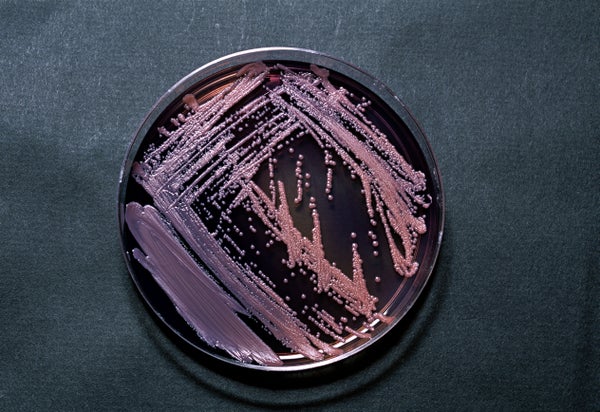
Just as most of the matter in the universe is thought to be “dark matter,” much of Earth is populated by a kind of microbial analogue: microorganisms that are known to exist but have never been grown in a laboratory.
A new study, published last September in mSystems, suggests such microbes could account for up to 81 percent of all bacterial genera that live outside the human body. These little-known organisms could hold the secrets to new tools for treating disease and could help us understand life in extreme environments, such as those on other planets.
.png?w=1350)
Credit: Amanda Montañez; Source: “Phylogenetically Novel Uncultured Microbial Cells Dominate Earth Microbiomes,” by Karen G. Lloyd et al., in mSystems, Vol. 3, No. 5; September/October 2018
On supporting science journalism
If you're enjoying this article, consider supporting our award-winning journalism by subscribing. By purchasing a subscription you are helping to ensure the future of impactful stories about the discoveries and ideas shaping our world today.
Microbes are the most abundant life-form on Earth. Researchers have sequenced the DNA of many species out in the field, but they can be difficult to culture in the lab, and scientists usually grow only one species at a time to study them in a controlled setting. To determine how much microbial dark matter exists, Karen Lloyd, a microbiologist at the University of Tennessee, Knoxville, and her colleagues compared all known microbial DNA sequences with the subset from species that have already been cultured. They then inferred the fraction of microbes that have been sequenced but never cultured (graphic). “We're discovering numerically that so many of the microbes on Earth are things we have never really learned anything about,” Lloyd says.
The sheer number of microbial species—possibly close to a trillion—means that scientists cannot possibly collect them all. Many species exist in hard-to-reach places, such as at the bottom of the ocean or under frozen Arctic soil. Furthermore, not all microbes can survive in cultures designed to nurture just one strain. Some can grow only in a far more complex, natural environment, notes environmental microbiologist Laura Hug of the University of Waterloo in Ontario, who was not involved in the study. “They get what they need from their community,” she says, “so that means you can't really grow them on their own.”
But Lloyd is optimistic. “We have made great strides with just the known microbes, and there are potentially even more discoveries hidden in these [unknown ones],” she says. “It leaves open the possibility for really grand discoveries.”