
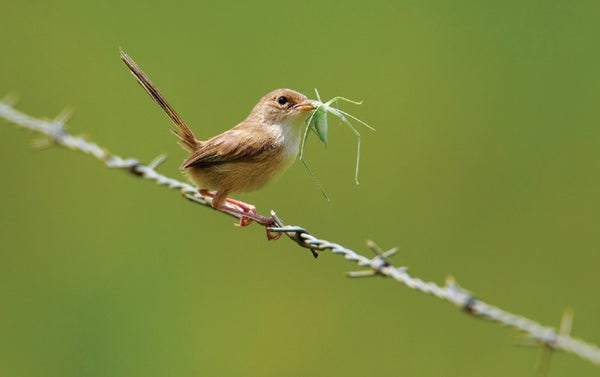
In utero, babies can tell the difference between loud sounds and voices. They can even distinguish their mother's voice from that of a female stranger. But when it comes to embryonic learning, birds could rule the roost. As recently reported in The Auk: Ornithological Advances, some mother birds may teach their young to sing even before they hatch. Newborn chicks can then mimic their mom's call within a few days of entering the world.
This pedagogy was first observed in 2012 by Sonia Kleindorfer, a biologist at Flinders University in South Australia, and her colleagues. Female Australian superb fairy wrens were found to repeat one vocalization over and over again while incubating their eggs. When broods hatched, the baby birds made the identical chirp to their mothers—a vocalization that served as their regular “feed me!” call.
To find out if the trait was more widespread in birds, the researchers sought the red-backed fairy wren, another species of Australian songbird. First they collected sound data from 67 nests in four sites in Queensland from incubation through posthatching. Then they identified begging calls by analyzing the order and number of notes. A computer analysis blindly compared calls produced by mothers and chicks, ranking them by similarity.
On supporting science journalism
If you're enjoying this article, consider supporting our award-winning journalism by subscribing. By purchasing a subscription you are helping to ensure the future of impactful stories about the discoveries and ideas shaping our world today.
It turns out that baby red-backed fairy wrens also emerge chirping like their moms. And the more frequently that mothers had called to their eggs, the more similar were the babies' begging calls. In addition, the team set up a separate experiment that suggested that the nestlings that most closely mimicked their mom's voice were rewarded with the most food.
This observation hints that effective embryonic learning could signal neurological prowess of progeny to parents. An evolutionary inference can then be drawn. “As a parent, do you invest in quality offspring, or do you invest in offspring that are in need?” Kleindorfer asks. “Our results suggest that they might be going for quality.”