
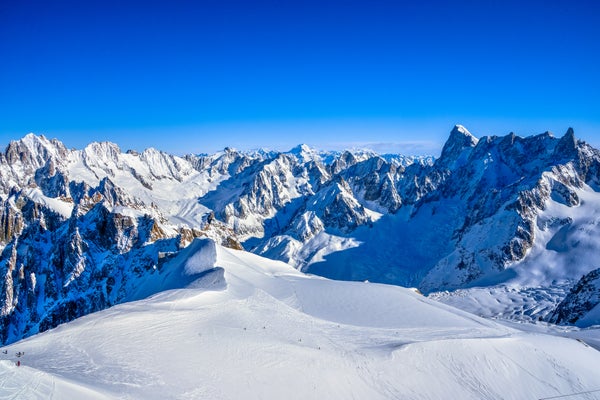
Melting mountain glaciers could account for nearly a third of the sea-level rise that’s occurred in the last 60 years, new research suggests. That makes their contributions to global ocean levels on par with the massive Greenland ice sheet and far more significant than Antarctica.
As glaciers melt, much of the water runs into nearby rivers and eventually into the oceans. So even though they tend to be located in mountainous regions of the world, they’re immediate contributors to rising seas.
The only bigger contributor to global sea-level rise is the warming of the oceans themselves, which causes water to expand.
On supporting science journalism
If you're enjoying this article, consider supporting our award-winning journalism by subscribing. By purchasing a subscription you are helping to ensure the future of impactful stories about the discoveries and ideas shaping our world today.
“Glaciers are, at the moment, one of the relevant drivers, and they will remain so over probably the next century,” said lead study author Michael Zemp, a glaciologist at the University of Zurich. “Because they are very sensitive—much more sensitive than the ice sheets—they are really causing the trouble now.”
That puts many regions at risk of losing ice cover in the coming decades. If the melting doesn’t slow down, the study suggests, glaciers would all but disappear by the end of the century in places like western Canada, the United States, Central Europe and New Zealand.
That makes the melting a problem in two ways. Not only will the glaciers continue to contribute to global sea-level rise—as long as they last—but local water supplies are likely to dwindle as they disappear. Summer melt from mountain glaciers is often an important source of fresh water for nearby communities.
“These mountain glaciers feed large populations,” said Alex Gardner, a glacier expert at NASA’s Jet Propulsion Laboratory. “Right now, they’re probably seeing an increase in discharge during the warm, dry months when these glaciers are contributing a significant fraction of the stream flow. But as we get out 50 or 100 years, that contribution is going to start to slow down.
“I think we’ll have a much more consequential impact in terms of water resources as that water reservoir is no longer available,” he added.
The new findings, published yesterday in the journal Nature, drew on a combination of field observations, collected on site from nearly 500 glaciers worldwide, and satellite data covering more than 19,000 glaciers. Combining that data allowed researchers to construct a time series of the melting that has occurred in regions all over the world, going back to 1961.
The length of the time series is a big advantage of the new work, Zemp suggested. And Gardner added that the new study may address some uncertainties scientists have had about previous estimates from the 1960s.
Broadly, though, the findings reinforce estimates from previous studies, which have also suggested that mountain glaciers are major drivers of global sea-level rise. A 2013 paper in Science led by Gardner also indicated that glaciers account for about a third of all recent sea-level rise, although that study focused on the period from 2003 to 2009.
The new study helps to highlight an issue with immediate consequences, said glaciologist Tad Pfeffer of the University of Colorado at Boulder. The Greenland and Antarctic ice sheets tend to garner the most attention when it comes to the issue of sea-level rise, mostly because their potential contributions are so enormous. The Greenland ice sheet contains enough ice to raise global sea levels by about 20 feet if it all melted away, and Antarctica could contribute a staggering 200 feet.
While scientists work to understand how quickly certain regions of those ice sheets could destabilize, their biggest contributions to sea levels are likely to occur over much longer time scales. On the other hand, as the new research confirms, mountain glaciers are one of the biggest drivers of sea-level rise right now—and their rapid disappearance also carries immediate consequences for nearby human communities.
It’s an issue that needs more attention, Pfeffer said.
“It’s very difficult to get funding to study small glaciers,” he explained, adding that the most pressing need for sea-level predictions, to help coastal communities prepare themselves, is for the period covering the next few decades.
“On that time scale, these mountain glaciers are probably still going to be the dominant thing, and we neglect them at our peril,” Pfeffer said.
In a general sense, the study of mountain glaciers emphasizes the speed at which climate change is already occurring, and the large-scale changes it’s already inflicting on landscapes all over the world.
“It’s bizarre that we’re able to sit here and within our lifetime watch a lot of these glaciers in these regions disappear,” Gardner said. “It’s kind of haunting to see these things disappear in front of our eyes.”
Reprinted from Climatewire with permission from E&E News. E&E provides daily coverage of essential energy and environmental news at www.eenews.net.