
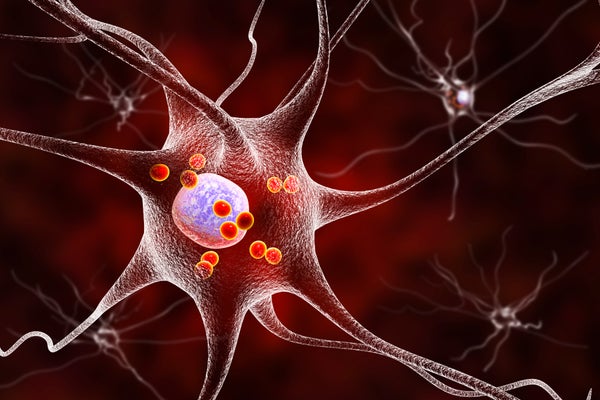
In 1912 neuroscientist Fritz Jacob Lewy published the first of three studies on structures he had identified in brains of people with "paralysis agitans." The condition came to be known more commonly as Parkinson's disease, and the structures Lewy identified were somewhat controversially named "Lewy bodies." He was so passionate about the discovery of these epononymous "bodies"—neuron-destroying tangles of a protein called alpha-synuclein—that he published a hefty tome in 1923 detailing his findings at levels of brain structure ranging from macro to microscopic. And then he never brought up Lewy bodies again.
Researchers are still trying untangle the mystery of how Lewy bodies form and lead to different types of dementia. New findings, published June 5 in Science Translational Medicine, may help point to some answers. The results show that a particularly destruction-resistant form of alpha-synuclein called fibrils accumulate in Lewy bodies and that brain cells can respond with a trio of proteins to tag these fibrils for breakdown.
This trio consists of members of the SCF (S-phase kinase-associated protein 1, cullin-1, and F-box domain–containing) protein family. In addition to the S and C proteins in this trio, the F protein in the group, called F-box/LRR repeat protein 5, or FBXL5, directs the tagging trio to specifically tag the destruction-resistant fibrils, sparing nonpathological versions of alpha-synuclein.
On supporting science journalism
If you're enjoying this article, consider supporting our award-winning journalism by subscribing. By purchasing a subscription you are helping to ensure the future of impactful stories about the discoveries and ideas shaping our world today.
The results offer new insight into how Lewy bodies may form, says Fredric Manfredsson, assistant professor of translational neuroscience at Michigan State University, who was not involved in the study. "Perhaps the most important aspect is the identification of a pathway that can be manipulated to clear misfolded or pathological alpha-synuclein from a cell," he says. That ability to target only the pathological fibrils is important, Manfredsson says, because although no one's quite figured out the functions of the other forms of alpha-synuclein, which can occur as single strands or just paired molecules instead of woven fibrils, clearing all of them might be harmful.
To pin down FBXL5 as thekey member of the trio for targeting only the disease-causing form of alpha-synuclein, Juan Atilio Gerez, a researcher at the Swiss Federal Institute of Technology in the Department of Chemistry and Applied Biosciences, and his colleagues first showed that brain tumor cells often used in this type of lab experimentproduce the SCF trio, including FBXL5 in response to taking up alpha-synuclein fibrils. Together, the rescue proteins, the team confirmed, kick off a process of protein destruction, tagging the alpha-synuclein fibrils to lure breakdown proteins called ubiquitins to the doomed molecule.
In brain tissues from people who actually had Parkinson's disease, the researchers found that at least two members of SCF targeted Lewy bodies. Turning to mice, Gerez and colleagues showed that introducing the fibrils into mouse brains triggered Lewy body formation, a process that intensified if the FBXL5 component of the trio was not functional.
Understanding how brain cells respond to a threat from alpha-synuclein fibrils is a promising development, Manfredsson says, because manipulating this pathway to enhance the brain's natural defense holds potential for future therapies.
The findings arise from work with cells and mice, however, so realizing the therapeutic potential of this approach in humans is, at best, in the earliest stages. "Lewy body formation remains an enigmatic process," Manfredsson says, adding that these results will require testing by several other approaches before researchers can fully establish clinical relevance.
Gerez says that he and his colleagues are currently doing just that: working with a variety of methodologies to see how activating FBXL5 and its related proteins in various ways affects alpha-synuclein fibril accumulation in different models. One thing the team will have to figure out is whether or not the SCF trio tags anything else. It might have other targets, he says, so even though activating it could clear pathogenic alpha-synuclein, it might affect other biological processes in undesirable ways.