
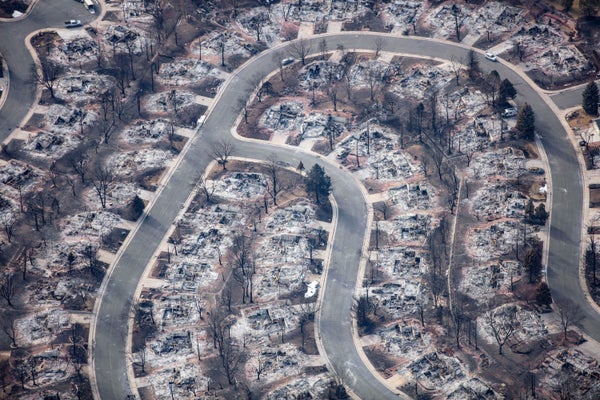
After three months of research, scientists say the cause and the intensity of the most damaging blaze in Colorado history remain a mystery.
Researchers participating in three separate studies to explore the 6,000-acre blaze, which began just before noon on Dec. 30, said they haven’t been able to pinpoint what caused the fire to destroy 1,084 houses and damage 37 commercial buildings.
One reason is that characteristics of the fire, which started in rural grasslands and then jumped an eight-lane highway before raging through two densely populated suburbs of Boulder, do not appear in computer models used to explore the potency of fires.
On supporting science journalism
If you're enjoying this article, consider supporting our award-winning journalism by subscribing. By purchasing a subscription you are helping to ensure the future of impactful stories about the discoveries and ideas shaping our world today.
Thousands of similar areas, which scientists call the “wildland urban interface,” or WUI, are common in the United States. But they “present a significant challenge for wildfire models,” explained Timothy Juliano, a researcher studying the blaze for the National Center for Atmospheric Research, which is located near two communities that experienced widespread damage, Louisville and Superior.
He and others who testified yesterday at a forum exploring the causes of the fire said the combination of dryness, strong westerly winds, and intense and long-lasting heat produced by tightly packed homes created a situation that needs more research to “improve future forecasting methods.”
Janice Coen, another NCAR researcher, says the National Science Foundation is paying for a survey of 400 people who lived in the perimeter of the fire to get a better sense of what started it and the damages it caused. It’s one of the top 15 most destructive wildfires in the western United States.
She said a fire in one area coupled with three fires from people burning debris in another area combined to cause the larger fire, but investigators have yet to publicly identify anyone who was involved.
Radar beams reflected from the fire’s smoke clouds show an area of whirling wind turbulence that scientists called a “hydraulic jump.” It turned strong westerly winds of up to 115 and 68 miles per hour in the two suburbs into a “rotor” of multi-directional winds that may have helped spread the heat and embers from the burning houses.
The fire occurred after both the Boulder area and nearby Denver had experienced what were among their driest late summer and fall periods in recorded history.
Last month, the Cooperative Institute for Research in Environmental Sciences (CIRES), a partnership of over 800 scientists working for the University of Colorado, Boulder, and at nearby NOAA laboratories, issued a study suggesting that future fires like this one could become more likely.
The study, appearing in the journal Science Advances, analyzed data from 28,000 fires between 1984 and 2018. It suggested that climate change is causing more extreme events, including some that are spreading into new areas.
It found that in the West and the Great Plains “the largest wildfires grew bigger and ignited more often in the 2000s.”
As one author, Virginia Iglesias, a research scientist at CIRES, put it: “projected changes in climate, fuel and ignitions suggest that we’ll see more and larger fires in the future. Our analyses show that those changes are already happening.”
Reprinted from E&E News with permission from POLITICO, LLC. Copyright 2022. E&E News provides essential news for energy and environment professionals.